How to Compare Indoor Playground Manufacturers in 2026
Seven key factors need to be examined when comparing indoor amusement equipment manufacturers in 2026: experience, safety certifications, customization, materials, installation, aftermarket support, and cost. These factors are important because indoor playground are a long-term investment. The right supplier of indoor play equipment can keep children safe, keep the business afloat and support years of revenue growth. A bad choice can lead to safety risks, expensive downtime and customer losses.
This article provides a comparative list of indoor amusement equipment manufacturers. Buyers can use it to examine each supplier and ask specific questions. Each section covers the main points to be examined and ways to verify information. This can help buyers find the best indoor play equipment maker for their needs.
Key Takeaways
- Check how many years a manufacturer has been in business and look at its list of items. This will help you judge its experience and reliability.
- Check safety certifications such as ASTM, EN and CSA to help keep children safe and compliant with local rules.
- Choose a manufacturer that offers bespoke designs to suit your space, brand and future needs.
- Ask about materials and durability tests. This can help you choose a playground that lasts longer and doesn’t require much maintenance.
- Compare all costs, including installation and aftermarket support, for best value for money.
Proven Experience of an Indoor Playground Manufacturer
Years in Business and Completed Projects
A company’s years of business experience is a testament to its experience and stability. Homebuyers should check how long the manufacturer of indoor rides has been operating and how many projects it has completed. Experienced manufacturers deal with material shortages, changes in safety rules and new design trends. This experience is important when making long-term investments.
A list of projects shows the type and size of projects the company has completed. Manufacturers installing playgrounds in many countries may have experience in production and transport. Buyers can ask for a list of items and look at installation dates, venue types and project sizes. The table below shows the major vendors by business and project experience as of 2026.
| Manufacturer | Founding Year | Years in Operation (as of 2026) | Project Scale Indicators |
| Soft Play LLC | 1984 | About 42 years | 40,000+ soft-contained play spaces installed in 70+ countries; about 2.6 billion children entertained |
| Guangzhou-based manufacturer | 1994 | About 32 years | Exports to 45+ countries; factory and office space of over 20,000 sq ft |
| Playpower (Lewisburg, PA manufacturer) | 1971 | 50+ years | IPEMA/ASTM certifications; part of the PlayPower group |
| Didi Land | 2014 | About 12 years | Products shipped to 40+ countries |
| Weiroo | 2015 | About 11 years | Serves 30+ countries; 1,000+ customers; 50,000 sq m facility |
| Dreamland Playground | Not stated | Estimated 10–15 years | Offers turnkey services, design, and installation |
| Next Level Parks | 2024 | About 2 years | Newer market entrant offering design, manufacturing, and installation in the United States |
Vasia Playground is another company buyers can consider. It has more than 20 years of experience in the playground equipment industry. The company focuses on safety, durability and custom design. Buyers can compare the experiences, products and program records of the nation’s leading indoor recreation equipment manufacturers when choosing a supplier.
References, Case Studies, and Reviews
Past customers can help buyers get to know manufacturers better. A company’s marketing materials may look good, but feedback from venue operators can provide a clearer picture of installation quality, safety and after-sales service. Buyers should request at least three customer certificates from a similar location, such as a mall, school or daycare centers.
When choosing an indoor play equipment supplier, consult three customers in a market similar to yours.
Case studies provide buyers with more details about the work of manufacturers. A good case study includes venue size, theme, budget and timetable. It also explains how manufacturers solved project problems. Buyers can compare these details according to their needs. A review of industry forums and trade publications would also be helpful. Positive feedback from multiple sources can be a good sign.
A reliable indoor playground manufacturer should be willing to share references and contact buyers and past customers. If the supplier refuses to provide a reference, the buyer should proceed with caution. When comparing manufacturers of indoor rides, check their records and look for clear evidence of past work. This helps buyers choose suppliers that meet their security and service needs.
Safety Certifications and Compliance Standards
Safety Certifications to Verify in 2026
certificates show manufacturers comply with accepted safety standards. Buyers looking for an indoor playground manufacturer should check that the equipment complies with local safety regulations. The following table lists the key standards and certifications in major markets.
| Region | Standard | Scope |
| USA | ASTM F1487 | Public playground equipment safety and performance |
| USA | ASTM F1918 | Soft contained play equipment safety |
| USA | CPSC Handbook | Guidance on playground safety and fall surfaces |
| Europe | EN 1176 | Playground equipment safety, including structure and materials |
| Canada | CSA Z614 | Children’s play equipment and surfacing safety |
| Australia/New Zealand | AS 4685.1 | Playground equipment safety |
| Global | ISO 9001 | Quality management systems for manufacturing |
These safety standards cover different aspects of playground safety. ASTM F1487 includes public playground equipment. ASTM F1918 covers soft play facilities commonly used indoors. Europe EN 1176 prescribes safety requirements for playground equipment. CSA Z614 addresses playground equipment and safety issues in Canada. IPSAS 4,685.1 covers playground equipment in Australia and New Zealand.
Buyers should be aware that an ASTM test report itself does not mean the product is approved for sale or use in the USA. ASTM standards are only part of the safety requirements. Climbing structures and rope systems also need to be checked for entrapment risks and fall prevention measures. Buyers should look for clear risk assessments, material details and safety records. Major manufacturers focus on safety checks, material quality and clear documentation.
According to Vasia, its indoor playground products meet ASTM, EN, CSA, AS and NZS standards. Purchaser shall provide relevant test reports and certificates upon request to confirm that the equipment complies with the rules of its target market.
Testing, Inspections, and Warranty Coverage
The Buyer shall provide the test report and inspection records upon request prior to the conclusion of the Contract. Third-party testing agencies such as SGS and TÜV can test materials and see if products meet safety standards. An ISO 9001 certificate indicates that the manufacturer has a quality management system, but not that the playground structure is safe. Buyers also need test reports and security documents for specific products they plan to buy.
Before opening, buyers should collect approved drawings, installation instructions, commissioning records, user manuals and maintenance plans. These documents help to ensure the safety of the equipment throughout its useful life. Risk assessments and inspection plans are also needed to check safety during routine use.
Warranty terms vary by component. The new playground has a structural warranty of 12 months to life, depending on the manufacturer and the parts covered.
New indoor playgrounds may have structural warranties ranging from 12 months to life, depending on the manufacturer and the parts covered. Old equipment that has been installed for 12 to 24 months may have a shorter warranty. Buyers should check the original purchase date and remaining warranty before buying used equipment.
Indoor rides come with a limited 18-month warranty on steel frames, slides, tunnels, fillings and mesh. Pill throwing devices and electric soft play devices may have similar terminology. Some parts, such as air beds and soft sofas, may have shorter warranties.
Buyers comparing indoor amusement park manufacturers should request written warranty terms. They should also check which parts are covered, for how long and under what conditions. Safety certificates, test reports and clear warranty documents can help buyers understand what they’re buying and avoid unexpected costs.
Customization Options from Indoor Playground Manufacturers
Design Flexibility for Space and Brand
Design flexibility helps make a play area unique. Buyers should check how well an indoor playground manufacturer can adapt the layout to their venue. The design should start with the limits of the space. Ceiling height, floor area, building structure, fire exits, and clear views all affect the layout. The target age groups, visitor capacity, and types of attractions also matter. If a supplier ignores these factors, the equipment may not fit the venue or meet its needs.
Brand identity also affects design choices. Independent operators often want fully custom layouts. Franchise operators may need to use approved suppliers and follow company design rules. The table below compares these two options.
| Feature | Franchise Model | Independent Brand Model |
| Upfront Fee | $30k – $60k | $0, with investment in assets |
| Monthly Fees | 6% – 8% royalty | 0%, keeping 100% profit |
| Equipment Sourcing | Corporate-approved vendors | Factory direct |
| Design Flexibility | Brand standards only | 100% custom |
| Software Choice | Mandatory system | Your choice, SaaS |
| Profit Potential | Shared with corporate | Fully yours |
Independent operators who want to customize a solution can work directly with manufacturers to control the design. Vasia Playground offers custom designs, themes and layouts to suit each brand’s needs.
Themes, Add-Ons, and Scalability
Theme options vary across the industry. Popular choices include jungle, space, ocean, pirate ship, candy, circus, city town, macaron, mini city, and sports. Leading indoor playground manufacturers build themes into the equipment instead of relying only on surface decorations. This helps keep the colors, graphics, and structures consistent and makes them easier to maintain while meeting safety needs.
Modular components make installation easier and allow future expansion. Buyers should check whether the indoor playground supplier offers replaceable modules, spare parts, and the required certification documents. Inclusive designs with sensory features and accessible play equipment can attract more visitors. Modular systems also let operators add new play zones as the business grows without replacing the whole structure. Vasia Playground offers modular components to support installation, maintenance, and future expansion.
Material Quality from an Indoor Playground Equipment Manufacturer
Core Materials and Construction Methods
Material affects the duration and maintenance costs of the play area. Buyers should request material specification sheet from each indoor playground manufacturer. This document should list foams, PVC, mesh, steel, fasteners, mats and covers. Be careful if the supplier only describes the material as “high quality” or “safe.” These words don’t provide enough information about quality.
Non-toxic materials help protect children from harmful chemicals. Foam padding, padded walls and rubber floors can reduce the risk of falls. Steel frame quality depends on wall thickness, galvanized quality and weld quality. Strength checks under static and dynamic loads were performed on the framework conforming to EN 1176-1: 2017. Foam density is also important. The density of commercial soft bubbles is usually 25 – 35 kg/m3. High-density foam can keep its shape under repeated use, while low-density foam can flatten out in a few months. Vinyl or polyurethane covers should be securely glued to the foam without gaps or peeling. This helps prevent damage and safety risks.
Durability, Cleanability, and Lifespan
Buyers should inquire about the wearability of the product, parts and components, and expected useful life under commercial use. Metal structures can last a long time if properly coated, painted or galvanized to prevent rust. Plastic surfaces should be mold-resistant, mold-resistant and easy to clean with soap and water. Regular checks for cracks and breakages can help keep plastic parts safe.
Water purifiers shall meet the safety requirements of the equipment. Buyers should check their carrying capacity, grid size and edge structure. Nets that lose tension in a short period of time may need to be replaced or inspected more closely. Fire-resistance should also be supported by reports of real-life foam, vinyl and mesh structures.
Spare parts are important for long-term maintenance. Upon request, the buyer provided part numbers and confirm that replacement foam blocks and headboards would be provided in the future. Without that information, repairs can be more costly.
Regular maintenance plans can help extend the lifespan of foams and mesh. Staff should check equipment daily, thoroughly clean it weekly, check net tension weekly, check bolt tightness monthly and check foam condition every three months. The schedule shall follow the manufacturer’s instructions and the equipment’s condition.
Vasia Indoor Playground states it uses durable, nontoxic materials for commercial use. The Purchaser shall, upon request, provide material specifications and test reports to verify these claims and to confirm that the equipment meets the safety requirements of its market.
Installation and Technical Support
Turnkey Delivery and Timeline Management
Turnkey delivery covers every step from the first discussion to the final handover. A good indoor recreation equipment manufacturer guides customers through consulting, design, production, installation, and aftermarket support. Each step builds on the last. Rushing or skipping a step can lead to problems later.
The process follows a clear sequence:
1.Consult: budget, target age group and venue restrictions are set before design begins.
2.Design: Create 3D images and customize CAD layouts. Check the venue, select a theme, plan capacity and divide play area by age group.
3.Production: commercial grade materials. Complete assembly and strength testing prior to delivery.
4.Installation: arranges transportation and customs clearance, then assembles equipment to maintain structural stability and safety.
Buyer shall confirm in writing the installation schedule, site preparation requirements and maintenance support. A clear timetable would facilitate planning by both sides. Site preparation can include levelling the floor, completing electrical work, checking ceiling height and clearance. Delays in these tasks can bring the project to a halt.
Many manufacturers offer turnkey services, but buyers should check what is included. Ask if site planning, 3D design, soft installation, debugging, and aftermarket support are included in a contract. At the same time, identify those responsible at each stage.
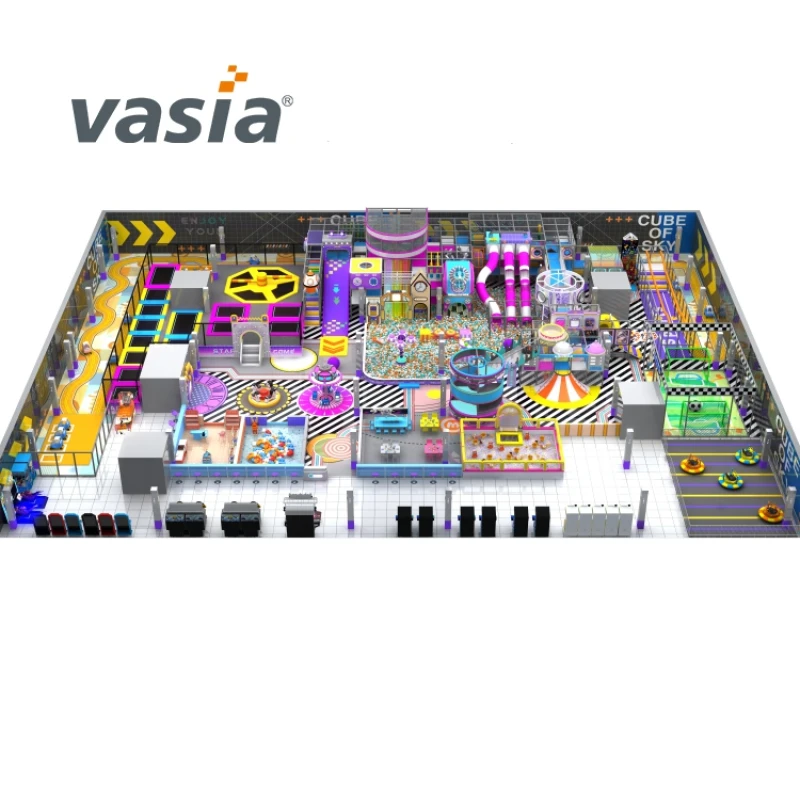
Vasia playground provides design, manufacturing and installation services. Working with a vendor at these stages can reduce coordination problems and lead to greater clarity of responsibility.
Post-Installation Support and Training
Installation is the beginning, not the end, of the relationship between operator and manufacturer. Training of staff should include routine safety checks, cleaning and emergency response procedures. Trained staff can spot frayed parts before they break. They can also enforce age restrictions and competency rules to help keep children safe.
Aftermarket support includes spare parts, maintenance plans and technical help. Buyers should ask how quickly manufacturers respond to spare parts requests. If the supplier has common parts in stock, replacement parts can be sent more quickly. Suppliers without inventory can keep operators waiting for weeks for critical repairs.
Vasia Playground provides operational guidance and after-sales support. Before signing the contract, the buyer shall confirm the services contained in the package and check response time, spare parts availability and maintenance terms.
Pricing and Long-Term Value
Reading a Cost Breakdown the Right Way
A reasonable offer should show all costs. Each indoor playground provider should provide a detailed cost breakdown. Equipment typically costs between $10,000 and $70,000, averaging about $35,000. The price depends on the size and complexity of the structure. Custom themes also add to the cost. Factory direct commercial equipment typically costs $10 to $15 per square foot.
Freight, installation and tariffs can add a lot to the total cost. Installation labor can be 15% to 25% of the cost of equipment. Seaborne freight may cost $3,000 to $15,000 per container, while inland freight may increase by $1,000 to $5,000.
The buyer should confirm warranty clause in writing before signing the contract. Lower equipment prices may not save money if hidden costs and limited warranty coverage lead to higher costs later.
Total Cost of Ownership Over Five Years
Smart home buyers will consider the total cost of buying a home, not just the price. A 5,000-square-foot facility may earn about $400,000 in its first year. Over five years, the franchise may earn between $440,000 and $540,000, including royalties and advertising. Independent businesses can spend between $170,000 and $250,000 on construction and equipment. These cost differences affect the return on investment.
Maintenance, spare parts and downtime also affect long-term costs. Durable equipment from reliable indoor playground manufacturers may require less maintenance. Fewer glitches also help reduce revenue losses. When comparing indoor amusement park manufacturers, buyers should consider the price of equipment, installation, maintenance services and other factors. The lowest price does not always provide the best value. Safe, durable equipment helps protect children in the long run and controls costs.
Buyers can use the list to vet any indoor playground vendors. Check the manufacturer’s experience, years of practice and customer credentials. Review market-required Safety certifications and testing reports such as ASTM, EN, CSA, AS, and NZS. Make sure the design meets your space, brand and future needs. Check material quality, cleaning convenience and expected service life. Check installation services and after-sales service to ensure proper operation of the venue. Compare total costs, not just equipment prices.
Before making a decision, ask for quotes, customer references and safety documents from at least three indoor amusement park manufacturers. Compare their responses using the same criteria. Check each supplier’s experience, product quality, design, installation services and warranty terms to find the right partner for your project in 2026.
FAQ
How many customer references should the buyer require?
Buyers should be required to provide at least three certificates from similar locations. Malls, schools and daycare centers have different needs. Reference books can help buyers understand installation quality, safety and after-sales service. Manufacturers should be willing to share these contacts.
Which safety standards are most important in 2026?
The main criteria depend on when the playground is open. ASTM F1487 and ASTM F1918 are suitable for different types of rides in the USA. EN1176 covers playground equipment in Europe. CSA Z614 applies in Canada and AS4685.1 in Australia and New Zealand. Buyers shall inspect the standards and certifications required in their local market and require relevant test reports from manufacturers.
Can manufacturers customise playing fields for small spaces?
Yes. ‘ Many manufacturers offer Modular components for different room sizes and ceiling heights. Buyers should measure usable floor space, entrances and structural limitations before requesting design. Custom themes and inclusive gaming features can also be tailored to suit different age groups, matching the brand.
What warranty should homebuyers expect?
Structural warranties range from 12 months to life, depending on the manufacturer and the parts covered. Indoor rides may come with a limited 18-month warranty on steel frames, slides, tunnels, fillings and mesh. Buyers should check the warranty terms in writing before signing a contract. They should also ask which parts are covered and under what conditions.
How does material quality affect long-term costs?
Durable materials can reduce maintenance costs and downtime. Dense foam helps keep its shape when reused. Properly galvanized steel frames can prevent rust and corrosion. The buyer should inquire about the wearability of the product, the availability of parts and components, and expected useful life under commercial use. These factors help buyers estimate the full cost of ownership over five years.