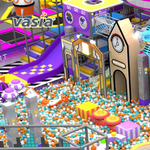
Commercial Playground Equipment Manufacturer vs Trading Company
A commercial playground equipment manufacturer builds what it sells. A trading company resells what someone else builds. That one difference shapes everything else. For most commercial projects, a direct manufacturer gives you stronger control over quality, customization, and accountability. A trading company still fits certain situations. The real problem is verification. Supplier claims are hard to check, and the indoor playground manufacturer vs trading company decision affects your budget, timeline, and safety. Certificates should name the legal manufacturer, product scope, and test method, not just carry a logo. This guide gives you a comparison framework, a verification checklist, and the questions to ask before you sign.
Key Takeaways
- A manufacturer makes the equipment it sells. A trading company resells equipment that other companies make.
- Working directly with manufacturers gives you more control over quality, customization, and who is responsible.
- Always check what a supplier claims. Look at their business license, take a live video tour, and ask for certificates that name the legal manufacturer.
- Pick a manufacturer for complex, custom, or long-term projects. Pick a trading company for simple, standard, or small orders.
- Before you sign any contract, ask detailed questions about production, certifications, warranty, and spare parts.
What Is a Commercial Playground Equipment Manufacturer?
Definition and Core Operations
A commercial playground equipment manufacturer is a company that runs engineering and production in its own facilities. This company owns the machines, the production lines, and the quality inspection teams. It does not just buy finished goods from another source and put its name on the box.
A true commercial indoor playground equipment manufacturer handles major production processes in-house. Teams for product development, production, and quality inspection all work under one roof. This setup helps design and manufacturing communicate clearly. You get to work with the people who actually build your equipment.
Why Direct Production Matters
Direct production gives you three practical advantages. First, you can talk with the engineering team about your project. Second, you can check production progress and quality checks. Third, you have one company to hold responsible for the final result.
A factory-direct producer also puts money into advanced manufacturing processes. According to Verified Market Reports, these processes include CNC machining, injection molding, and eco-friendly coating techniques. These skills let firms make complex, customizable designs at scale. Real-time quality monitoring also lowers defect rates and helps meet strict safety certifications.
The table below shows how a direct manufacturer differs from a supplier or distributor.
| Factor | Manufacturer | Supplier or Distributor |
| Product Source | Direct manufacturing | One or more manufacturers |
| Customization | Based on factory capabilities | Based on supplier relationships |
| Product Range | Manufacturer’s own portfolio | May include multiple brands |
| Technical Communication | Direct production communication | Coordinated through supplier |
| Installation | May require local contractors | May offer local installation |
| After-Sales Support | Manufacturer or service partners | Supplier or service partners |
This comparison shows why a direct factory relationship works well for custom projects, bulk orders, and specialized setups. You get direct answers, direct oversight, and direct responsibility. An indoor playground equipment manufacturer that builds its own products can stand behind every part it ships.
What Is a Trading Company?
Definition and How It Operates
A trading company is a middleman. It buys playground equipment from other factories and sells it to you. It usually does not own a factory, machines, or production space.
These businesses work through coordination. Lucky Play Group says a trading company adds value by finding suppliers, communicating, handling exports, and coordinating factories. The company connects you with factories, does the paperwork, and manages shipping. You get one contact for quotes, documents, and delivery updates.
This setup has a real limit. Technical questions may go through several people before they reach the real production team. Changes to sizes, colors, load requirements, access routes, or safety details can cause delays or mixed answers.
A direct manufacturer controls or manages engineering, materials, production, testing, and often installation. A trading company usually coordinates products from one or more outside factories. Buyers should check who really handles production instead of trusting only the supplier label.
That warning matters when you compare quotes. A trading company may show nice catalogues and drawings, but the final design depends on an unnamed subcontractor’s skills. Ask if the quoted supplier made the drawings, owns the tooling, controls the bill of materials, and can make replacement parts.
Where Trading Companies Add Value
A trading company works well for some projects. You get many product choices when you need several unrelated categories from one contact. You also get local market knowledge and convenience for small or standard orders.
Time pressure is another factor. If you cannot reach factories directly, a reseller can handle that work for you. The model works best when your order is simple, your specifications are fixed, and you do not need deep engineering help. Keep your expectations realistic about customization and technical support in this setup.
Indoor Playground Manufacturer vs Trading Company: Key Differences
Side-by-Side Comparison
The indoor playground manufacturer vs trading company comparison gets easier to see when you line up the factors that affect your project. Lucky Play Group explains how each model handles product control, customization, communication, quality visibility, responsibility after delivery, and product range. The table below takes that framework and applies it to the factors you will weigh during playground procurement models.
| Evaluation Factor | Direct Manufacturer | Trading Company | What It Means for You |
| Customization | Stronger for integrated, project-specific designs | Often strongest for standard or multi-source products | Match the supplier model to your design complexity |
| Communication | Direct access to engineers and production managers | May involve an additional communication layer | Confirm response times and escalation procedures |
| Quality Control | Factory audits, in-process checks, and pre-shipment inspection can be arranged | Depends on the transparency of partner factories | Request inspection records and traceable specifications |
| Lead Times | Production schedules set in-house | Coordinated across external factories | Ask who controls the timeline when delays occur |
| Pricing and Margin | Factory direct pricing with no reseller markup | Includes the trading company’s margin | Compare total value, not just the unit price |
| Installation Support | Manufacturer may provide or coordinate installation | May offer local installation through partners | Clarify who is responsible on site |
| After-Sales Service | Usually clearer for replacement parts and technical modifications | Depends on agreements with factories | Read warranty exclusions and after-sales terms carefully |
| Accountability | Single point of responsibility | Shared between trader and factory | Verify who owns the bill of materials and accepts technical responsibility |
Reading the Comparison for Your Project
You should weigh each factor against three things: how complex the project is, your budget, and your long-term goals. Dreamland Playground advises choosing an indoor playground manufacturer when your project needs a lot of customization, direct access to engineers, long-term support, greater quality control, a large investment, or brand differentiation. A commercial indoor playground equipment manufacturer meets these needs through in-house engineering and production teams.
A trading company fits a different profile. Dreamland Playground suggests a trading company when your project is fairly simple, you need products from multiple industries, you prefer consolidated supplier management, local sourcing help is valuable, or customization needs are limited. For smaller projects with limited product varieties, trading companies are more efficient.
Manufacturer or Trader: Choosing the Right Partner for Your Playground Project
The factory versus trader decision ultimately depends on your project’s details, your purchasing strategy, and your resources for dealing with suppliers. Large projects usually require customization, engineering review, safety compliance, installation planning, and long-term maintenance support. Working directly with a manufacturer makes these steps easier to coordinate. Manufacturers may save on intermediary costs, but the total cost depends on project size, customization, and long-term support. Many family entertainment centers focus on expertise, accountability, safety, and total project cost and value rather than the low up-front cost of the equipment.
Lucky Play Group notes that direct communication with engineering and production teams is especially valuable when the venue changes during construction. Ceiling height, columns, fire exits, HVAC routes, sprinkler locations, doors, or floor levels may differ from the original plan. A commercial playground equipment manufacturer can normally revise fabrication drawings and assess the consequences faster than a broker who must get new feedback from an external factory. This difference in responsiveness often matters more than the quoted price when your schedule is tight.
Customization and Design Flexibility
Working Directly with Engineering Teams
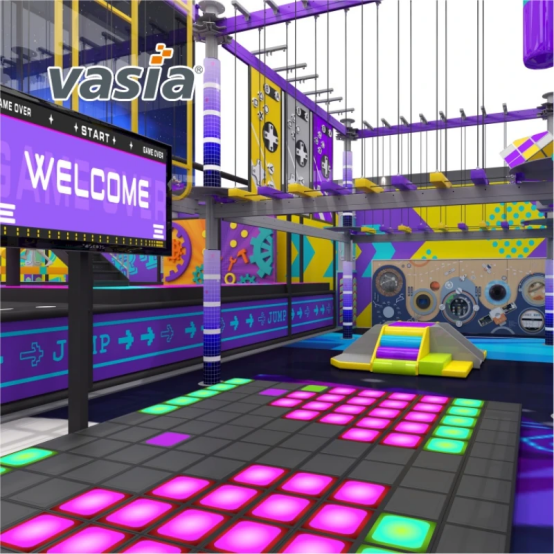
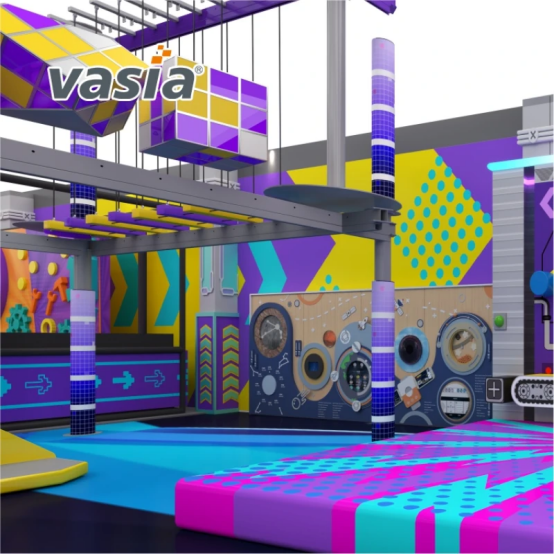
A direct manufacturer turns your idea into drawings before production starts. You explain your space, your audience, and your brand. The engineering team then builds a custom indoor playground based on those details. Vasia Indoor Playground shows how this works in real life. Its team adjusts each design to fit floor size, ceiling height, theme, colors, layout, and target age group. Soft-play parts and child-friendly materials create a comfortable space for active play. You also approve a custom 3D design before production begins, so you sign off on the theme, color, layout, and play features ahead of time.
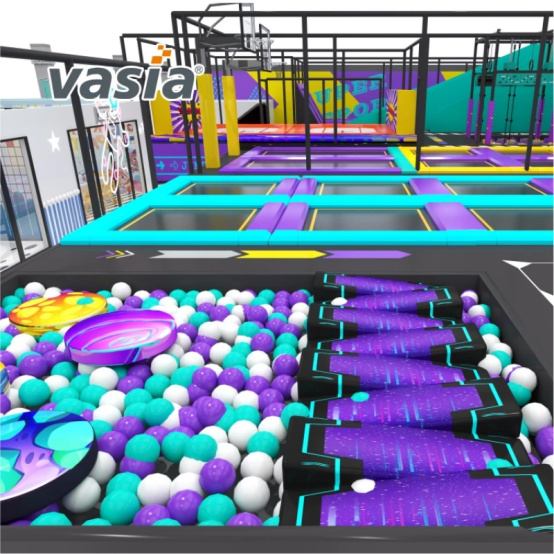
Theme choice shows the range a custom indoor playground manufacturer can offer. Vasia provides indoor themed playground equipment in many styles:
- Dinosaur Theme
- Jungle Theme
- Ice & Snow Theme
- Ocean Theme
- City Role-Play Theme
- Ninja Course Theme
- Trampoline Park Theme
- Interactive Projection Theme
This factory direct access keeps your changes close to the people who build the equipment. You talk about changes with engineers, not messengers.
Customization Through a Middleman
A trading company takes your request and passes it to a factory. Each round of changes goes through an extra layer. Ninghow describes this pattern in its sourcing comparison. A direct manufacturer usually gives you better control over samples and revisions. A trading company handles standard custom work well, but bigger changes may need more back-and-forth. Details can also get lost between you and the actual production line.
| Aspect | Direct Manufacturer | Trading Company |
| Customization depth | Better for technical changes and refinement | Good for standard work; deeper changes need more back-and-forth |
| Communication speed | Direct to the source | Messages pass through an intermediary |
| Revision cycles | Stronger control over sampling and revisions | Margin pays for coordination and problem solving |
When a style needs many revisions, sample development and approval matter more than a low quoted unit price. The party that manages sampling best often controls the final product best, according to Ninghow.
Plan your revision rounds early. Ask any indoor playground manufacturer who approves samples and who signs off on the final design.
Communication and Project Coordination
Direct vs. Relay Communication
When you work with a manufacturer, you talk to the people who build your equipment. Questions about materials, dimensions, or safety details go straight to the engineering team. Answers come back the same way. This direct line keeps technical details correct and saves time. You also know who makes each decision, which helps when a problem comes up on site. Keeping written records of these talks protects you if a dispute arises.
A trading company puts an extra layer between you and the factory. Dreamland Playground notes that talking through the buyer, trader, and factory makes supplier management simple. But it can cause trouble for technical questions and changes while the project is running. The table below shows where this relay model causes friction.
| Challenge Area | Communication Challenge with a Middleman |
| Project Communication | Technical questions and changes go through an extra party |
| Customization | Design revisions depend on the partner factory’s experience |
| Quality Control | The trader relies on the manufacturer’s quality system |
| Lead Times | Production progress and priorities are outside the trader’s control |
| After-Sales Service | May require factory involvement |
Handling Change Requests
Change requests test any supplier relationship. A factory direct manufacturer can revise drawings and judge the impact on cost and schedule fast. Your request goes straight to the production team, and you get a clear answer about what changes and when. Problem solving stays inside one company, so responsibility is easy to trace. You can also ask for a written change order that lists the new price and delivery date.
A trading company must send each request to its partner factory. Revision cycles take longer, and details can get lost in the handoff. Dreamland Playground explains that the trader depends on its production partner for progress updates and does not control production priorities. Timeline adjustments follow the same pattern. Before you sign, ask who approves changes and who confirms the new schedule. A clear answer now prevents disputes later.
Quality Control and Safety Standards
Who Owns the Production Process
A factory direct manufacturer runs the whole production process from start to finish. That control leads to tighter quality control and steadier adherence to structural integrity standards, according to Construction Today. The same source notes that in-house engineering lets a manufacturer show exactly how its products meet ASTM F1487, the playground safety standard many jurisdictions, insurers, and risk managers require.
You should check this ability instead of just trusting it. Ask for facility documents, production certifications, and proof of manufacturing ownership. Ask detailed questions about the materials used for structural elements, platforms, fasteners, coatings, plastics, and high-wear areas. Then ask for third-party testing proof. Supplier claims about durability mean little without independent proof. A commercial indoor playground equipment manufacturer with its own lines can answer these questions directly. A reseller often cannot.
Certifications to Verify
Safety documents should reach you before you sign a contract. A numbered test report from an accredited lab such as SGS, TÜV, Intertek, or Bureau Veritas is useful safety evidence. Check the report number, and make sure the certificate covers the exact design, components, and materials in your quotation. A valid report for one model does not always cover a custom layout.
| Standard or Mark | Market or Scope |
| ASTM F1487 | US public playground equipment |
| ASTM F1918 | Soft-contained indoor play equipment |
| EN 1176 | Europe |
| AS 4685 | Australia |
| CSA | Canada |
| CPSIA | US children’s products |
| CE, TÜV, SGS | Third-party conformity review |
ISO 9001 certification also shows steady quality management processes, according to ATX Playground. Good indoor playground equipment manufacturers give current compliance documents without any hesitation. Vasia states that its products meet ASTM, EN, CSA, AS, and NZS requirements.
You can check that claim against the documents. Ask about the ASTM F1918 report, read what it says, and confirm the lab’s name. This separates checked safety compliance from sales claims.
Lead Times, Pricing, and Total Value
Where the Margin Goes
Factory-direct pricing takes out the reseller markup from your quote. You pay for materials, labor, engineering, and the manufacturer’s own profit. A trading company adds its margin on top of the factory price. That margin pays for coordination, sourcing, and problem solving. Neither model is always cheaper. A small standard order may cost less through a reseller who already holds stock or combines shipments.
Compare total value, not just the unit price. Ask what each quote includes: drawings, testing documents, packing, shipping coordination, and spare parts. Factory-direct buying often includes engineering review in the price. A reseller may charge for changes it cannot price accurately. Duomi Play Area warns that a trading company prices a change by guessing, and low guesses tend to show up again on the final invoice.
Delivery Reliability and Hidden Costs
Delivery reliability shows which suppliers are strong and which are weak. A professional factory tells you about a delay on day five, while there is still time to re-sequence the line or split the shipment. A weak supplier tells you the day before loading. Duomi Play Area notes that a delivery date belongs on the proforma invoice with a stated consequence if it slips. Verbal dates are estimates, not commitments.
Hidden costs tend to gather around unchecked promises. Duomi Play Area describes the trading company that says yes to everything, then adds a surcharge during production. Custom colors add five to seven days on their own. Peak season orders pile up from September to November. A production lead time of fifteen to twenty days starts when the deposit clears and the drawings are signed. Ocean freight adds another fifteen to thirty-five days. Factory-direct sourcing keeps these steps visible, so you can plan the full schedule instead of finding out late.
Installation and After-Sales Support
Who Handles Installation and Warranty Claims
Installation duty follows the same split as production. A direct manufacturer can send its own crew or approved partners to your site. That team knows the drawings, the hardware, and the order of steps. When a part does not fit, the crew reports it to the same company that built the equipment. Warranty claims also go to one place. You file the claim, and the manufacturer checks it, decides, and ships a replacement without asking a third party for permission.
A trading company rarely installs anything itself. It either gives you a manual or hires a local contractor it does not control. Warranty claims turn into a relay. The trader sends your photos to the factory, the factory answers, and the trader sends the answer back. Each step adds delay. Ask who signs the installation acceptance form and who pays for a return visit if a part fails. Get that answer in writing before you sign.
Vasia shows how a turnkey indoor playground manufacturer handles this work. The company provides design, manufacturing, and installation services from start to finish. One contract covers the whole project, so installation and warranty stay with the party that built the equipment.
Long-Term Parts and Service
Playgrounds wear out in places you can predict. Slides, padding, netting, and fasteners need replacement over the years. A factory direct supplier keeps the original specifications and tooling. You can reorder a matching part years later, and it will fit the frame you already own.
A trading company may lose that trail. Its partner factory can change designs, retire molds, or stop answering. You then face a custom fabrication job for a simple spare. Ask any supplier for a spare parts list, a stated availability period, and the name of the team that handles service requests. A clear service commitment protects your investment long after the opening day.
How to Verify a Real Manufacturer
Practical Checks
You can prove a real factory exists by using independent evidence, not just a nice brochure. Start by checking the business license. A license the supplier emails you is weak proof. Looking it up in a government registry like GSXT or SAMR is strong proof. Use at least three separate checks before you trust any claim.
Next, ask for a live video call that is not scripted. Have the supplier walk to specific production stations you choose, not play a recorded tour. At a real plant, you can look at the steel-tube welding and bending station and ask about tube diameter and wall thickness on a current order. Commercial-grade frames usually measure about 48mm across with a 2.0-2.5mm wall. On the foam line, ask to see the density label on the roll in use; commercial soft-play foam is usually 60-80 kg/m3. At upholstery, check the PVC tarpaulin roll and the stitch pattern; commercial-grade tarpaulin is around 1100 GSM. At the QC station, ask for a live load or fastener-torque check, with Grade 8.8 fasteners as the baseline. ISO/IEC TS 17012:2024 notes that remote video is not a full substitute for an on-site visit, so a real factory will also accept a follow-up call within the hour to show other parts of the floor without warning.
Third-Party Pre-Shipment Inspection: Costs and AQL Sampling Requirements
For orders of $10,000 or more, or with custom tooling, book a third-party pre-shipment inspection. SGS, Bureau Veritas, Intertek, and TÜV Rheinland usually charge $200 to $400 per person per day, or about 0.5-0.6% of FOB value with a $350 minimum. The inspector comes once production is 100% complete and at least 80% of units are packed, pulling samples per ISO 2859-1 (AQL).
Finally, check customs and export records on Panjiva, ImportYeti, or ImportGenius. Panjiva holds over 2 billion shipment records across more than 9 million companies, and ImportYeti offers a free option with roughly 70 million records updated daily. Match the shipment name to the exact contracting entity. Two or more red flags on independent channels is your sign to walk away.
Red Flags to Watch For
A trading company pretending to be an indoor playground factory often shows warning signs. Watch for vague answers about where the facility is or which production stations it has. Technical documents that do not match, and safety documents that do not name the legal manufacturer, also raise concern. Be wary of claims about scale, partnerships, or capacity that no independent record confirms. Sudden name changes or a quick jump into a trending product line deserve a closer look. A supplier that cannot pass a factory direct video walk-through, or that refuses a follow-up call, is probably not the actual manufacturer. Use these checks before you compare any indoor playground manufacturer vs trading company, and confirm the direct factory owns its production line.
Questions Should I Ask Before Choosing an Indoor Playground Manufacturer?
Production and Facility Questions
Begin with the factory itself. Ask what the supplier builds in-house and where the plant is located. Request a live video tour of the welding, foam, and upholstery stations. CY Playgrounds suggests a factory audit or a third-party inspection before a large order. Ask for production samples, third-party lab test results, and visits to reference installations that show long-term wear.
Then look closely at the quality system. Ask how the factory tracks specifications from incoming materials to final packing and how it handles parts that fail standards. An ISO 9001 certificate describes a management system, not product safety, so check its scope and current status. Confirm which certifications apply to your market, such as ASTM F1918 for the United States. Ask how the supplier reports a manufacturing deviation and what acceptance process applies when goods differ from the approved specification. Request a written production timeline with approval deadlines and dispatch milestones.
Customization, Warranty, and Service Questions
Ask about the design process. A strong indoor playground equipment manufacturer keeps senior designers in-house and can turn your vision into a custom indoor playground with modular parts you can swap later. Approve final drawings, colors, materials, and the component list in writing before production. The contract should require prior approval for any substitution that affects dimensions, price, or delivery.
Warranty terms deserve the same careful review. Ask how you submit a claim, what evidence you need, who pays freight for replacement parts, and whether labor is covered. Confirm the start date, exclusions, and how wear items differ from manufacturing defects. Request spare parts lead times and a maintenance schedule with routine inspection points. Certified installation protects your warranty, and improper installation voids it, according to Far Kids Island. These questions should i ask before choosing an indoor playground manufacturer turn vague promises into checkable commitments.
When a Trading Company Fits Best
Scenarios Where Resellers Make Sense
A trading company can be a good choice in some playground buying situations. Think of a small daycare that needs a standard soft-play set with fixed sizes and no design work. A reseller who already has stock or combines shipments can deliver that order faster than a factory waiting for a custom production slot. The same idea applies when you need local sourcing help. A trader who speaks your language and knows your import rules can handle paperwork you would otherwise have to learn from scratch.
Buying from several categories is another good fit. Suppose your venue needs playground equipment, furniture, and flooring from three unrelated industries. One trading company can bring those purchases together under a single contract and a single shipping schedule. You trade engineering depth for easier administration, and that trade makes sense when your specifications are simple and your customization needs are limited.
Managing the Risks
Risk management starts with knowing what you are buying. Yommi Play reports that a trading company often adds a 20% to 60% markup to the factory’s base price, hidden as a project management fee or brand premium. The same source warns that 30% to 50% of certificates held by traders are borrowed or fraudulently obtained. Check every certificate against the issuing lab’s database and serial numbers before you commit.
| Risk | How You Can Manage It |
| Price markup | Know the markup is hidden; the same equipment comes from the factory |
| Fake certificates | Check serial numbers against the lab database |
| Split production | Avoid traders who spread one venue across several factories |
| Material shrinkage | Require steel pipes 1.5 mm to 2.0 mm thick and PVC leather 0.45 mm to 0.55 mm |
| Fake factory tour | Demand to see raw material racks, the finished goods workshop, and scrap bins |
Lock the design before production begins. Yommi Play notes that late forced changes can shrink safety clearances and delay the schedule. Factory-direct sourcing gives you the CAD files and part tolerances that make after-sales diagnosis possible. Factory-direct purchasing also keeps the real factory accountable for the whole build. Ask for a written contract that names the legal manufacturer, and confirm that entity through a live video walk-through of the real factory floor.
The Turnkey Manufacturer Trend
What Turnkey Service Includes
Turnkey service means one commercial indoor playground equipment manufacturer takes care of design, manufacturing, and installation. You sign one contract and work with one team from the first idea to opening day. CY Playgrounds explains this model in detail. Its turnkey packages cover design, theming, and customer experience. They include in-house CAD work, 3D visualization, and layout guidance for sightlines, throughput, and mixed-age zoning. The same package includes on-site installation by accredited installers, inspection reports after installation, staff training for safe operation, and scheduled maintenance with spare parts logistics.
| Service | What It Covers |
| Design and theming | In-house CAD, 3D visualization, themed environments, revenue-driven layout guidance |
| Installation | Accredited installers and post-install inspection reports |
| Training | Staff programs for safe operation |
| Long-term maintenance | Scheduled packages, spare parts logistics, annual safety audits |
CY Playgrounds reports that CY Play runs a production base of more than 10,000 ㎡ in Panyu, Guangzhou. Design, custom manufacturing, installation, and long-term operational support all happen under one roof. That range matters when you order indoor themed playground equipment and commercial indoor soft play equipment for the same venue.
Why Buyers Are Consolidating Suppliers
Buyers consolidate because split responsibility creates gaps. Kanbei Play notes that customized and large-scale family entertainment center projects now treat design, production, installation, and commissioning as one process. The construction period is scaled to the project size. The same source says leading manufacturers support full non-standard customization. They also optimize layouts around beams, columns, and irregular floor shapes to maximize usable space.
A factory-direct producer also shortens the chain between your request and the finished build. Established suppliers like Vasia, one of the top five playground equipment suppliers in China since 2000, show this consolidated model. Vasia handles design, manufacturing, and installation for turnkey indoor playground projects, so one party answers for the whole result. Kanbei Play advises confirming the construction period, customization scope, after-sales cleaning, and the full service set before you sign. Treat factory direct sourcing as a package, not a price tag. Ask any indoor playground manufacturer which services stay in-house and which they subcontract.
A commercial playground equipment manufacturer builds what it sells, and a trading company resells what someone else builds. Verify that difference with a business license check, a live video walk-through, and certificates that name the legal manufacturer. Then match the model to your project. Complex, customized, or long-term work favors a direct manufacturer. Simple, standard, or small-volume orders may suit a reputable trading company. Before you commit, run the question checklist from this indoor playground manufacturer vs trading company guide. Ask about in-house production, certifications, warranty terms, and spare parts. Clear answers protect your budget, your schedule, and the children who play on the result.
FAQ
How can you quickly tell a manufacturer from a trading company?
Ask for a live video tour of the welding, foam, and upholstery stations, with no script. A real factory will agree right away. A reseller stalls, sends a recorded tour, or gives vague answers about where the plant is. Check the business license in a government registry, and match the shipment name to the company you are contracting with.
Can a trading company deliver a fully custom indoor playground?
Yes, but expect limits. The trader passes your request to a partner factory, so every revision goes through an extra layer. Deep technical changes, unusual sizes, and themed layouts depend on that factory’s skills. Before you sign, confirm who approves samples and who owns the drawings.
Which documents should you request before paying a deposit?
Ask for the business license, a numbered test report from an accredited lab, and certificates that name the legal manufacturer. Make sure the report covers your exact design and materials. Ask for a spare parts list and a written production timeline. Vasia states that its products meet ASTM, EN, CSA, AS, and NZS requirements.
Does buying factory-direct always cost less?
No. Factory-direct pricing removes the reseller markup, but a small standard order may cost less through a trader who holds stock or combines shipments. Compare total value instead: drawings, testing documents, packing, shipping coordination, and spare parts. One source reports trader markups of 20% to 60% hidden as fees.
Who handles installation when you buy through a reseller?
Usually a local contractor the trader does not control. Warranty claims then become a relay between you, the trader, and the factory. Ask who signs the installation acceptance form and who pays for a return visit if a part fails. A turnkey manufacturer keeps design, installation, and warranty under one contract.