The Complete Guide to Indoor Amusement Park Equipment Components
Indoor amusement park have different types of equipment. These include soft play facilities, trampoline systems, climbing facilities, interactive and electronic play facilities, ride simulators and support facilities. Each type is suitable for different age groups and play styles.
Buyers need to understand the type of equipment before planning a car park. This helps them plan layouts, meet safety standards, set clear budgets and manage future maintenance. This guide explains the main types of equipment, their uses, and how they work together. It also helps buyers review equipment proposals and examine security documents.
Key Takeaways
- Indoor park has six main equipment groups: soft play, trampolines, climbing structures, interactive games, simulators and support facilities.
- Each team is suited to a different age and style of play, so choose your gear according to your target visitors.
- Ask for safety certificates and test reports for the exact model of equipment you plan to buy.
- Make a maintenance plan early, as some parts wear out faster than others.
- Compare suppliers in terms of design, materials, security and services, not just price.
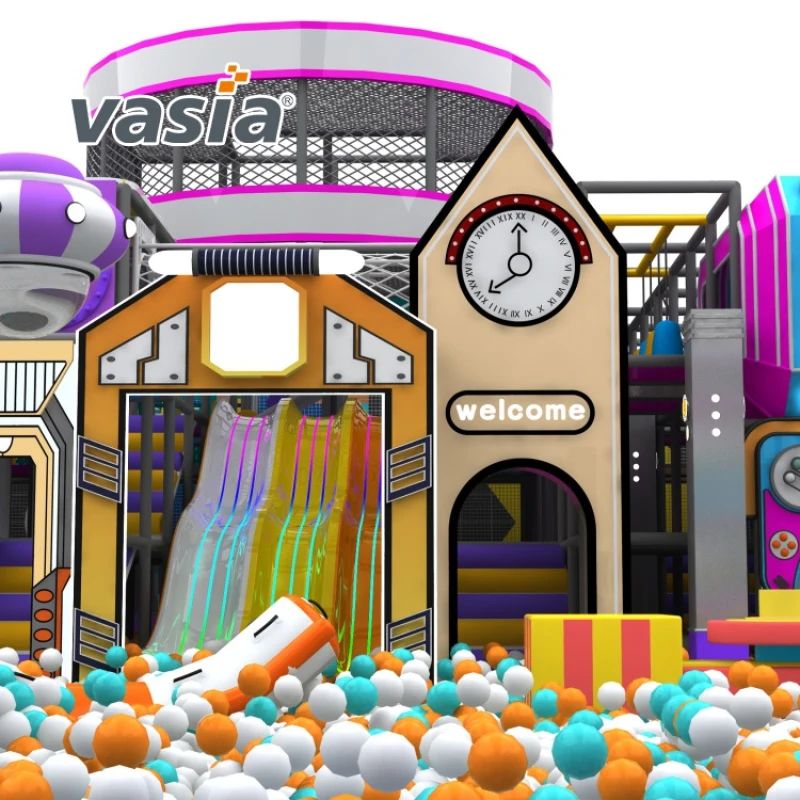
Indoor Amusement Park Equipment Categories
Core Component Families
There are six main types of indoor amusement park equipment. Soft play systems include multi-tiered play frames, slides, tunnels, rock climbing boards, ball pools and foam pits. Trampoline equipment includes trampolines, springs, steel frames, safety pads and safety nets. Rock climbing and adventure architecture includes climbing walls, cargo holds, rope courses and ninja elements. Interactive and electronic attractions include projection games, sensor-based games, arcade machines games and bonus counters. Sports simulators and attractions include motion platforms, seats, restraints and control systems. Amenities include flooring, lighting, sound control, entry gates and a ticketing system.
Each team has its own safety rules, wear and tear components and maintenance requirements. A clear list of equipment groups helps buyers review supplier proposals.
Each device group plays a different role in the guest experience. Soft play is for toddlers and kids who need a safe, filled play area. A trampoline attracts older children and teenagers who enjoy jumping and tricks. Climbing structures help children build courage and coordination. Interactive attractions are for all ages and offer quieter activities between active play sessions. The simulator provides an exciting ride in a small space. The amenities help keep the park safe, comfortable and manageable.
Consumers who buy indoor rides should choose one that suits their target age and style of play before comparing prices. This helps them plan equipment lists and create realistic budgets. Equipment not suitable for the main age group can still be an added attraction. .
How Categories Work Together
A typical layout connects all device groups on a clear path. Designers can create a main entrance that gets guests excited and helps them find their way. Themed attractions attract visitors to different areas and reduce crowding near the entrance. Towering equipment can reach the far end of the park, spreading visitors throughout the space.
Guests can walk about three minutes to food outlet, bathrooms or other attractions. Active queues can include games or digital activities to keep guests busy while they wait. Mobile apps can offer virtual queuing to reduce waiting times and encourage spending in shops and dining areas. The entrance has a touristy vibe, with the exit path guiding guests past shops and photo spots.
There are several spatial planning methods that can help increase visitor flow:
- Multi-level structures, climbing nets and suspension members use vertical space to increase carrying capacity without taking up more floor space.
- Make a clear distinction between high-energy, moderate and quiet areas of activity.
- Open sightlines help staff observe visitors from different areas.
- A looped layout eliminates dead ends and reduces crowding.
- CAD models and pedestrian flow simulations help test capacity and visitor movement before construction.
These methods apply to both indoor playground equipment and trampoline park equipment. Buyers who understand the major equipment group can explain their needs more clearly to suppliers. When reviewing indoor play equipment, homebuyers should ensure that its structural components, play parts and soft play systems are laid out in a consistent manner. Clear categories of equipment also help buyers plan repairs and discuss terms of service with suppliers..
Indoor Playground Equipment and Soft Play Systems
Play Frames, Slides, and Tunnels
Multi-level play frames supports most indoor playground structures. They use galvanized steel to prevent rust and hold parts together with sturdy joints. Workers check the strength of each weld and joint. Slides are available in straight, spiral, tubular and acrylic types for ages 3 -12. Tunnels and rock climbing slabs connect to different levels, giving kids more ways to explore.
Stuffing covers exposed edges and columns. Foam mats or EVA tiles help absorb impact of sliding and climbing structures. Safety nets use strong nylon or polyethylene.
Soft play equipment manufacturers should provide test reports for ASTM F1487, EN 1176 and AS 4685 and, where possible, TÜV or SGS certificates. Buyers should ask for information before signing a contract when viewing indoor rides for sale. They should also check what standards apply to equipment and installation sites.
Ball Pools, Toddler Zones, and Padding
Soft play systems include ball pools and nursery areas, so buyers need to choose their materials carefully. TPU foam have low VOC emissions and are formaldehyde-free. XPE foam is lightweight and free of phthalates, BPA and formaldehyde. Natural rubber is a durable option made from natural materials.
EVA foam can test for F963, CPSIA, and EN 71 standards, but buyers should also check for formamide levels. PE foam provides cushioning and does not require formamide-based softeners. PU leather surfaces are easy to clean. The goldcertified version of GREENGUARD has low chemical emissions. Organic cotton is GOTS certified but has less cushioning. Natural latex can be GOLS certified, but can cause allergic reactions.
A responsible manufacturer of indoor soft play equipment should provide material certificates and test reports. Buyers should check the safety, durability and wearability of the materials when shopping for indoor rides. Soft rides require durable lids and non-slip pads. All soft play parts should be made of materials that meet the safety requirements for their intended use.
Trampoline Park Components
Jump Beds, Springs, and Frames
The trampoline wears out faster than the rest of trampoline park equipment. Buyers should compare the life of the carpet before choosing a supplier. Cheap low-grade polypropylene mats have little UV protection and can last 1-2 years before fading, tearing or stretching. Better cushions made with UV-tested polypropylene, sturdy edge stitching and a tight weave can last three to eight years, or about 2.5 million jumps. Indoor exercise string mats can be used for 1 – 5 years depending on usage.
UV exposure is a major cause of pad damage. Weather, excess weight and heavy use can also shorten the life of cushions. Damaged stitches around D-ring, small tears, uneven bounces and creaks under load were all signs the pad needed replacing.
Frames and springs affect bounce quality and service life. Heavy duty galvanized steel tubing is thick and welded securely to help resist bending, rust and breakage. Double galvanizing provides corrosion protection. Longer, thicker, rust-resistant galvanized springs provide smoother bounce and a longer service life. The count of springs is also important, but so is the length and texture of the springs.
Weight rating helps buyers compare the strength of the frame, springs and cushions. Smaller family trampolines can be rated between 200 and 250 lbs, while premium systems can support 400 lbs or more. Buyers should check springs for damage, loosening or cracking before each transaction. Replace damaged springs with compatible parts approved by the manufacturer.
Safety Padding, Netting, and Accessories
Padding and netting help protect jumpers, so buyers should check jumpers against relevant safety standards. ASTM F381 overlays frame by filling and setting the required impact absorption to help protect users from hitting the frame. ASTM F2225 covers containment lines. It requires the net and its straps to pass a crash test without breaking. It also sets out requirements for net height and secure bottom attachments. ASTM F2774 covers the quality of trampoline mats, while ASTM F2970 sets general safety requirements for commercial trampoline parks.
Buyers should request third-party testing reports from SGS, TÜV or Intertek. They also provide safety data sheets for foams and adhesives upon request. These documents can help buyers check the performance of materials such as flame resistance and UV resistance.
Regular maintenance helps ensure that trampoline equipment is safe and reliable. The equipment is inspected before each use, and every few weeks, for early detection. New beds and springs can take up to two weeks to open.
Wash the bed with a gentle detergent and soft brush. Beds in busy or sun-soaked areas are repainted once a year. Apply UV protection on vinyl covers once a month. Cover the equipment with a tarp when it is not in use and remove snow as quickly as possible.
Climbing and Adventure Structures
Climbing Walls and Holds
. The table below shows the main choices.
| Component | Material options | Key notes |
| Climbing holds | Plastic, wood, ceramic, concrete, natural rock | Plastic comes in many shapes and colors. Wood has a softer feel, and natural rock looks realistic. Any hold may have hidden flaws that can cause it to break. |
| Wall sub-frame | Wood or steel | The frame supports the climbing surface, much like a house frame supports a wall. |
| Climbing surface | Plywood with textured coating, concrete, fiberglass composite, prefabricated panels | Simple climbing walls often use 3/4-inch plywood attached to a frame. |
| Surface coating | Sand-textured paint, acrylic textures, resin-based concrete | The area around each T-nut must stay flat and even. |
Climbing frames usually have one central 3/8-inch bolt with 16 threads per inch. Very large cargo holds may require two or more bolts. Builders should comply with the Climbing Wall Association (CWA) Specifications.
The support structure must bear its own weight and the mountaineer’s load, so engineers should redesign it. The walls should be covered with 3/4-inch ACX exterior-grade plywood, as lower-grade plywood allows T-nuts to pass through. Vertical studs are usually spaced 16 inches apart, and steeper walls may require wider studs.
Bolt length is important for safety. Use 3/ 4 inch plywood with bolts extending at least 3/4 inch beyond the rear of the cargo bay. Homebuyers should check the rides in detail in their proposals.
Rope Courses and Ninja Elements
Rope courses and ninja elements need to be checked regularly. Inspectors follow industry standards from groups such as ACCT, ASTM, BSA, CWA, PRCA and ISO. Annual inspections include rope courses, ninja classes, rock climbing walls and ziplines. Inspectors inspect structures, wire ropes, ropes, bolts and wooden parts. They also check that the required documents and manuals are available and complied with.
Indoor inspection areas should be well lit and inspection tools should be easily accessible. Inspectors give oral reports at site and usually submit written reports within 10 days.
Staff and access are also important during inspections. At least one trained staff member should be on site for emergencies. Inspectors need access to all parts of the course, including elevated areas, so doors should be opened and ladders ready. Manufactured belay devices require annual maintenance, with serial numbers and repair dates recorded. TÜV should inspect the facility before it opens and guides should be trained under EN 15567. These steps help ensure indoor rides are safe and secure.
Interactive and Electronic Attractions
Projection and Sensor-Based Games
Interactive flooring turns a flat surface into a playarea that responds to movement. A projector displayed games and images on the floor. Built-in motion sensors track how guests move. The software responds immediately, so a a child’s steps can create splashes, fractions or color changes. These systems are suitable for different age groups and waiting spaces.
Highlights of the interactive floor system include:
- Ground Projector: Shows games and images on the floor.
- Motion sensor: detects movement and tracks user movements.
- Software: Run games and react to action.
An optional white interactive floor mat can help when the floor is dark or carpeted. It makes the projected image easier to see and provides a softer surface that may reduce the risk of injury. Systems like Beam, Obie and EyeWiz have turned open indoor spaces into interactive play areas.
Buyers should check sensor coverage and brightness of the projector to make sure they are appropriate for the size of the room..
Arcade and Redemption Components
Arcade area work best when all machines work together. Each machine has a definite role. It can attract players, sell tickets, serve more guests or make the venue stand out. Traditional exchange games, such as”Lost Pirate” and Galaxy Hunter,”form up the main exchange area. Premium racing games such as Asphalt 9 DX Plus and Moto Blitz DX Plus also offer ticket rewards. This gives players an exciting experience and the chance to win tickets. Large group attractions such as HYPERGRID bring people together to keep guests busy between scheduled events.
Winning games add more options and create new ways to earn money. Pincer machines, gift game machines and capsule toy machines offer different types of rewards. Passenger flow is also important. Clean aisles, queue areas, comfortable viewing spaces and convenient exchange counters help guests move around. Bright LED lights, eye-catching machine displays, digital jackpot signs and prize showcase cases attract players. Exchange zones encourage repeat play, longer access times and more spending per visit.
When planning arcade areas, operators should check ticket value, payout rates, game costs and passenger traffic.
Ride Simulators and Motion Attractions
Motion Platforms and Seating
The sports platform supports the rider’s full weight and moves along set path. Builders typically use sturdy steel frames for commercial applications. The platform has to handle a lot of routine and reliable work with few glitches. Seats are fixed directly to the platform, so the anchors and brackets must be as strong as the frame.
Designers have also restricted the movement angle of platforms. These restrictions help prevent sudden tremors and unsafe positions. Authorized components should be used only in platform and seating assemblies. Suppliers can provide CE, RoHS, TÜV, SGS and SASO certificates to certify that the equipment meets certain safety or product requirements. Buyers should check which certificates are suitable for their market and request relevant documents and structural drawings.
Restraints and Control Systems
Constraints are the last line of defence against any motion attraction. Horizontal bars, shoulder straps and seat belts suit different ride types. As all platforms move, each restraint must keep riders safe. Operators should check the locking mechanism before each session and record each inspection.
Control systems connect platforms, constraints, and effects, allowing them to work together. Cycling should not start until all the restrictions are locked down. Emergency stop buttons must be easy for staff to touch. Programmed movements must remain within the approved motion angles. Regular software checks staff training also help to ensure safe driving. These tasks should be included in regular equipment maintenance schedules.
Supporting Facility Components
Flooring, Lighting, and Acoustics
There’s a lot of foot traffic on the ground, so every area needs the right ground. Soft playgrounds need flooring to absorb impact. Arcades and queue areas need hard floors that are easy to clean. The buyer should ask the supplier about the grade of non-slip and wear resistance.
Lighting should help people see and stay safe. It should not cause glare or discomfort. Designers should work with engineers to plan lighting and ventilation to keep the site comfortable. An HVAC system help control air flow and temperature. Acoustics should also be part of the building plan.
Different areas, such as karting zones, arcades and children’s play areas, require different levels of light and sound. Each area may need its own lighting setup and sound controls. These systems should be planned from the start along with building structures and containment structures. This makes installation and routine operations easier and helps keep the site comfortable and safe.
Entry, Ticketing, and Guest Flow
Ticket and ticketing systems determine the first and last impressions of a visit. Rotating doors, wristband printers and self-service kiosks help guests get in quickly. Clear ticket counter layouts help reduce queues at busy times.
Designers should plan how these parts work together. Entry gates should be close to the main line of sight so guests can see the attraction from the moment they enter. Ticketing systems should be linked to capacity limits so staff can track the number of guests in each area. Clear signs should guide guests from the entrance to the first attraction, exit, shop and food court.
Buyers should include admission and ticketing systems throughout the playground equipment plan. The entrance design affects staffing, income and crowd control.
Vasia Playground Indoor Playground Solutions
Founded in 2000, Vasia Playground is one of the top five providers of rides in China. Its indoor playground products include a slide, trampoline, rope courses, ninja track and soft playground. The company serves shopping malls, schools, daycare centers and family entertainment centers. Buyers who want to buy indoor rides from Vasia can get a complete package, not just individual parts.
Custom Themes and Modular Components
Vasia designs custom indoor playgrounds with modular sections. These sections allow for flexible layouts to accommodate different site sizes. Blue and purple make the space more noticeable. Soft safety padding cover play area to help reduce collisions and injuries. Separate exercise areas, puzzles and sitting areas help visitors move easily.
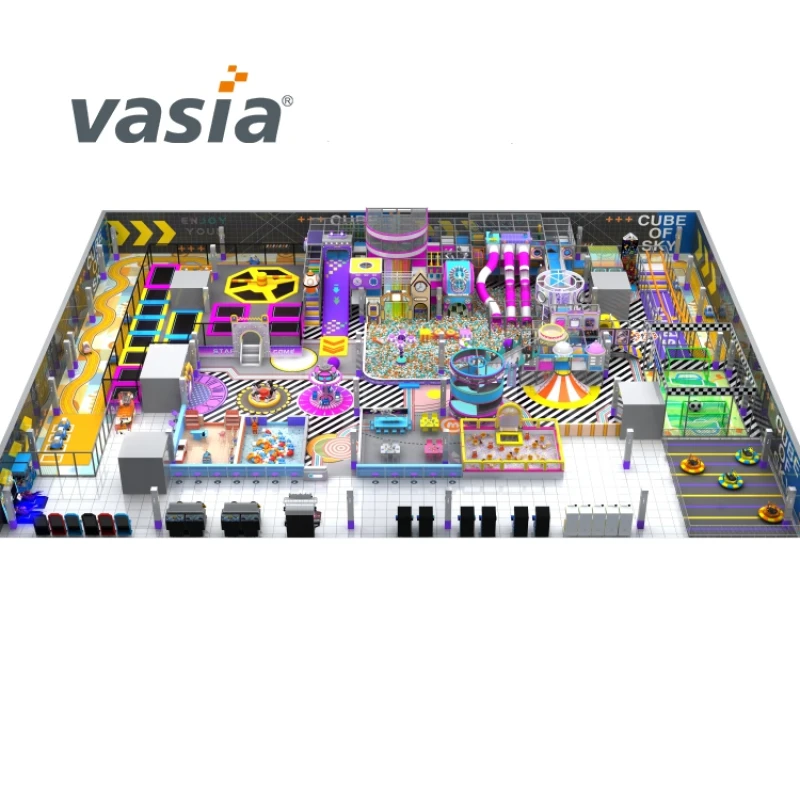
One example is a macaron fairy-tale themed playground with a ball pit, a glowing slide and multi-story climbing frames. An interactive projection theme is also provided.
The table below sums up the main customization options.
| Customization Aspect | Details |
| Tailorable attributes | Dimensions, colors, themes, and layouts |
| Construction style | Modular construction for flexible zoning |
| Available themes | Dinosaur, Jungle, Ice & Snow, Ocean, City Role-Play, Ninja Course, and Trampoline Park |
| Design process | Custom 3D design, CAD floor plans, and high-quality visualizations |
Inclusive designs welcomes children with different abilities. Vasia also customizes indoor rides and soft play systems to match different themes and meet different gaming needs. As a manufacturer of soft play equipment, the company provides solutions for a range of indoor play spaces.
Design, Manufacturing, and Installation
Vasia offers indoor playground design and full service from original concept to final handover. The team creates a custom 3D design prior to production and prepares a CAD floor plan with precise dimensions and play areas. High-quality photos help buyers check themes, colors, layouts and playback features before production starts.
The company says its production follows EN 1176 and ASTM F1918, which cover playground safety. The sliders are made from imported engineering plastics, the carpet has a wear rating of 80,000 and Scottish pine adds strength and durability. Spain Spain One 3,000 m2 indoor playground that has been in operation for five years and requires low maintenance.
Payment terms include a 30% deposit and 70% preshipment balance. Buyers can choose EXW, FOB or CFR shipping terms. Services include pre-shipment inspection, remote technical support, a one-year warranty and lifetime service.
These services include indoor playground equipment, trampoline park equipment and indoor adventure playground equipment. The Buyer shall confirm the applicable safety standards and require a record of the inspection of the particular equipment ordered by the Buyer.
Project Services for Indoor Attraction Equipment Suppliers
Layout Design and Customization
A full service package from an indoor attraction equipment supplier starts with layout planning. The design must fit the actual building, not just a standard drawing. Buyers should ask four key questions before approving the layout.
| Proposal Element | Question to Ask |
| Structural fit | Does the design match the current ceiling height, floor load, and column spacing? |
| Timeline | Do the design, drawing, and construction times line up with your opening date? |
| Local code | Did the designer think about your country’s fire and building codes? |
| Site prep | Is any demolition or structural change needed, and is it included in the price? |
Commercial indoor playground customization goes beyond equipment layout. Proposals should cover age groups, visitor capacity and overall guest journey. It should also show how party rooms, seating, cafés and ticketing fit into the business.
Proposals should include safety documents, local specification requirements and a clear timeline outlining the the buyer’s tasks. It should also explain in simple terms what is and isn’t included, warranty terms, spare parts and staff training.
Buyers who want to know about the design of indoor rides and turnkey projects should confirm all these details in writing before entering into a contract.
Installation, Testing, and Handover
Installation follows a clear sequence. The team plans the work of other on-site activities and ensured that the flooring and power supply were ready. The team then delivers and examines each package. Workers assemble steel frames, attach them to the floor and check their position. They then install play components, cushions, safety nets and impact absorbent surfaces.
The test range includes structural stability, fasteners and smooth operation of sliding and moving parts. The team inspected the equipment in accordance with the applicable requirements of EN 1176 or ASTM F1918. The installation was completed with one last walkthrough.
Experienced teams can install a mid-sized commercial indoor playground within 1-2 weeks, depending on site conditions and project size. The Purchaser shall request a detailed schedule listing the date of delivery, installation, inspection, repair and delivery. They should also identify who is responsible for security, who reports deficiencies and who approves the work completed.
Qualified personnel must handle structural work, electrical work and floor anchoring. The Buyer shall inspect the equipment and installation warranty before work begins. Installation checklists and inspection reports help keep records of projects. Orders for each playground equipment should be securely documented. equipment buyers indoor rides should consider handover a formal step.
Safety, Quality, and Lifecycle Evaluation
Standards, Certifications, and Documentation
Safety standards in different countries can help buyers check the safety of their devices. Key standards include ASTM in the USA, EN in Europe, CSA in Canada, AS in Australia and NZS in New Zealand. The supplier should specify precise criteria for each claim. For example, EN 1176-1 covers general safety requirements, EN 1176-3 covers slides, and EN 1176-10 covers fully enclosed rides. A certificate for a product category does not cover all products sold by the company. The buyer should check whether the model on the certificate is the same as that on the quotation.
Buyers should also check all technical documents carefully. The test report shows the test methods, samples and results. This does not prove that subsequent products or material thickness will meet the same requirements. Material reports cover only the samples tested, not the entire structure. CE marking is a declaration by the manufacturer that the product complies with EU requirements. That doesn’t mean the EU has approved it.
Buyer shall also collect CAD drawings, load calculations, welding records, dimension records, factory acceptance test results and site inspection signature documents. Material traceability is too important. Foam density, steel grade, tube wall thickness and net strength shall be accompanied by batch records or supplier documents. Claims such as “eco-friendly”should be accompanied by technical data sheets.
Maintenance Planning and Component Lifespan
A good maintenance plan can separate the main structure from the faster-wearing parts. If properly maintained, steel structures typically last 10 to 15 years before major repairs can be made. Netting and PVC covers may need to be partially replaced in advance. Parts with high friction wear out the most. These include trampoline mats, foam pit blocks, and PVC covers at slide exits. Foam pit blocks and trampoline mats also wear out faster than structured foam because they are always directly affected. Operators should develop separate replacement schedules for these components based on the number of visitors, cleaning methods and inspection results.
Operators shall prepare written maintenance plans and perform routine inspections, periodic inspections and maintenance records. Staff should document every defect and replacement to help plan for future maintenance. Supplier shall provide operation and maintenance documentation at the time of handover. These should include inspection schedules and a list of spare parts. Buyers should confirm warranty coverage and after-sale support in writing before signing a contract. Parts availability and service response times can affect long-term costs.
Choosing an Indoor Amusement Park Equipment Manufacturer
Building a Supplier Brief
A good project profile can provide the same information to each vendor. Buyers will need to provide a floor plan of the site, usable floor space, ceiling height, target age group, expected opening times, preferred attractions, subject matter requirements, delivery location, scheduled opening date and known local rules. They should indicate any details that may change at the planning stage. This helps suppliers avoid treating early estimates as final demand.
The profile should also explain what services the buyer needs. Some suppliers only manufacture and ship equipment. Others can help with conceptual design, layout planning, customization, installation, and setup. The Buyer shall list in writing all services required. The design image does not always include construction drawings, site supervision or construction service work.
A complete brief covers these items:
- Space dimensions, drawings and clear heights
- Target age group and operational objectives
- Theme Direction and attraction preferences
- Budget scope and delivery location
- Compliance requirements and target opening dates
- Scope and responsibilities of services required
Comparing Proposals and Specifications
Fair comparison starts with design, not price. Buyers should request detailed equipment lists and layouts from each interior attraction supplier. The list should include play features, number of floors, platform area, nursery area, safety nets, floor mats, themes, signage and spare parts. Low equipment prices may not include design work, transportation, installation or spare parts. A more complete offer may include some or all of these costs.
A comparison table can help buyers see each offer on the same basis. Buyers should give each vendor the same floor plan and questions, then compare and score the same answers.
| Criterion | What to compare |
| Layout fit | Dimensions, safety clearance, circulation, exits, column and sprinkler clearance |
| Materials | Steel pipe thickness, galvanization, foam type and density, netting strength |
| Safety documents | Which components each standard covers, edition, evaluator, and test reports |
| Customization | Included play events, levels, theming, signage, spare parts |
| Service scope | Installation support, maintenance guidance, warranty and after-sales support |
Buyers looking for indoor rides to sell should request photos of the materials and details of the safety standards that each product meets. Drawings may look similar, but materials and construction quality can be very different. Buyers should also make sure suppliers are following the right standards for their market, such as ASTM F1918 and relevant CPSC guidelines in the US. These checks can help buyers compare prices fairly. It also makes it easier to compare offers on commercial indoor rides.
Indoor amusement park equipment is divided into six main categories: soft play equipment, trampoline equipment, climbing equipment, interactive amusement park equipment, ride simulator equipment, auxiliary equipment. Each group has different components, wear and tear items and maintenance requirements. Project services link these components through layout design, installation, testing and formal handover. Buyers shall review each proposal based on safety documentation, material quality and expected maintenance costs.
First, prepare a vendor brief covering site dimensions, target age group, topic, budget and security requirements. Ask each supplier for quotes based on the same information and compare offers. A good plan should meet guests’ needs, follow required safety standards, and control long-term costs. .
FAQ
What do buyers need before contacting suppliers?
Buyers need site plan, usable floor space, ceiling height, target age group, theme, budget and safety requirements. Written briefings give the same information to each vendor. This makes proposals easier to compare and helps suppliers prepare offers based on the actual on-site conditions of indoor amusement park equipment.
How long will it take to install?
Experienced teams can install a medium-sized commercial indoor playground in a week or two. Time depends on site readiness, delivery date and inspection. The Buyer shall confirm in writing the delivery, installation, testing and delivery schedule prior to commencement of work.
What documents do homebuyers need to provide?
The Buyer shall, upon request, provide a test report indicating the standard, material certificates, CAD drawings, load calculations and factory acceptance test results to be used. They should check that each certificate matches the exact model in the quote. Reliable manufacturers of indoor amusement park equipment shall provide the required documentation upon handover of the project.
How often do worn parts need to be replaced?
Worn parts require different replacement schedules. Trampoline mats, foam pit blocks, netting, and PVC covers often wear off faster than steel frame. Operators should set replacement times based on visitor numbers and inspection results. Daily inspection and repair records help track wear and tear and plan future maintenance.
What makes a proposal easier to compare?
Buyers should compare layouts, material specifications, security documents, customization options and service ranges. They should use the same criteria to review every offer for indoor rides sold. Once those details match, buyers can compare prices more fairly. Clear terms of service and security records help protect guests and project budgets.