Indoor Playground Industry Business Plan Made Simple
An indoor playground business plan may seem hard, but it gets easy once you split it into nine normal parts. The U.S. Small Business Administration lists them: an executive summary, a company description, a market analysis, an organization and management section, a service or product line, a marketing and sales plan, a funding request, financial projections, and an appendix. You do not need past business experience to learn the basics of starting an indoor playground. Each part builds in a natural way on the one before it. This guide uses simple words and real examples, so you can work through the indoor playground industry plan with confidence, one step at a time.
Key Takeaways
- Write the executive summary last. It should point out cash flow, collateral, and a clear repayment plan to impress lenders.
- Look into nearby families and other indoor playgrounds. Use drive-time studies and income numbers to guess demand and set your prices.
- Pick safe, high-quality equipment. Vasia playground products meet safety standards and can be customized for your space.
- Plan your money carefully. Show cash flow month by month, break-even math, and stress tests. These prove your business can repay loans.
- Build your plan one section at a time. Start with the company description, then use templates or feedback to make your draft better.
Executive Summary Essentials
What to Include in One Page
You write this page last, even though it comes first in the document. By then you know your numbers, your customer, and how much money you need. The summary just packs those facts into one easy-to-read page.
Cover five things: what your playground offers, who it serves, where it runs, how much money you need, and how you will pay it back. Add a short sentence about your legal structure and ownership. Skip the long story about your childhood dream of opening a play center. Lenders want facts they can check.
Why Lenders Read It First
A loan officer looks at this page before anything else. Your summary either earns a full read of the plan or ends the talk. Build it around money, not big dreams.
| Key Element Lenders Look For | What It Means to Lenders |
|---|---|
| Cash flow | Lenders check whether the business makes enough clean cash flow to pay the loan. |
| Collateral | Assets that lower the loan’s risk and give a backup for repayment. |
| Clear repayment plan | A realistic, math-backed schedule showing how and when the loan will be paid back. |
| Financials-first framing | Lenders care more about financials and repayment math than growth stories that appeal to VCs. |
“SBA loan officers and bank lenders are deciding whether you can pay them back. They want clean cash flow, a realistic repayment plan, and collateral that lowers the loan’s risk. Growth doesn’t excite them the way it excites a VC. Lead with financials and repayment math.”
Put your repayment schedule near the top of the page. State the loan amount, the monthly payment, and the month you expect to cover it from operations. Name the collateral you pledge, such as equipment or a leasehold interest. End with one line on your experience running a business or a children’s facility. That mix answers the lender’s real question: can you pay this back on time?
Describe Your Indoor Playground Business
Mission and Legal Structure
Begin this section with a mission statement that is easy to understand. Say what your indoor play space offers and who it serves. A strong mission might read: “We give local families a safe, clean place where children learn through play.” Keep it to one or two sentences. Next, describe your legal structure. Most new owners pick a limited liability company, or LLC, because it keeps personal assets safe from business debts. A sole proprietorship costs less to set up but gives you no such protection. List the owners and their roles. Say whether you plan to run as a franchise or an independent venue. This choice shapes your business model, your fees, and how much control you have over branding.
Choosing the Right Location
Location decides how many families walk through your door. Weigh five factors before you sign anything.
| Factor | What to Consider |
|---|---|
| Foot traffic | Choose a site with lots of foot traffic, like shopping malls, commercial districts, or spots near popular family destinations. |
| Demographics | Study the local population to make sure your offerings match nearby families’ needs and preferences. |
| Parking and accessibility | Check that there is plenty of parking and easy public transportation access so families can reach you easily. |
| Competition | Survey existing indoor playgrounds nearby to judge the competition and find gaps your unique offerings can fill. |
| Lease versus rent terms | Leasing gives you stability and control but needs a longer commitment and more money upfront; renting gives you flexibility and a lower upfront cost but may come with periodic rent increases. |
Review rent escalation clauses, maintenance responsibilities, and restrictions on space modifications. Treat the lease as a core part of your indoor playground business plan, not an afterthought. A careful site review protects your investment and makes your case to lenders stronger.
Market Analysis for the Indoor Playground Industry
Good market research comes first in any indoor playground business plan. You need proof that people want your service before you spend money on equipment or a lease. This section shows lenders that you know the indoor playground industry and the families who will visit your business.
Research Local Families and Competitors
Start with the people who live near your site. Study four demographic categories, and note how each one affects your demand.
| Demographic Data Category | What to Analyze | Relevance to Indoor Playground |
|---|---|---|
| Population & Household | Total residents, household size, who lives together, family life stage, and expected growth | Shows the current market size and future demand; households with children are the main target |
| Household Income | Median/average income and how income is spread out (e.g., high >$150K, middle $50K–$150K, low <$50K) | Shows spending power; higher-income households have more extra money for fun outside the home |
| Education | Education levels of households | Education strongly affects spending on fun outside the home (college-educated households spend much more) |
| Age Distribution | Age groups, especially families with children from infant to 12 years old | Directly points out the target customers for a children’s indoor playground |
Income needs close attention. Households earning $50,000–$69,999 spent 76% more on fun outside the home than those earning $30,000–$39,999. Families above $70,000 spent almost four times as much as the $30,000–$39,999 group. Count the families with children from infant to 12 years old within a 15–20 minute drive. Use drive-time analysis instead of a simple radius, because travel barriers change the real market reach. The average North American family visits a family amusement center 3.2–4.6 times per year and spends $12–$22 per visit. These numbers give you a starting point for revenue estimates.
Next, run a competitive analysis. Visit every rival venue and write down entry prices, party packages, membership fees, and peak-hour crowds. This competitive analysis shows gaps you can fill, such as a cleaner toddler zone or a better party room. Map the competition in the area by drive time, not distance alone. Note how many rivals sit inside your trade area and what each one charges. A crowded market is not always bad, but you must show how your venue is different.
Seasonal demand patterns belong here too. Colder months in seasonal climates raise foot traffic and revenue. Weather-based tourism peaks and extreme temperatures push families indoors, which makes indoor playgrounds a smart advantage. Plan weekday specials and summer break partnerships to keep cash flow going in slower periods.
Define Your Target Customer
A clear customer profile makes the plan stronger and sharpens your marketing spend. Your target market includes several distinct groups. Toddlers and preschoolers, ages 1–5, form the largest visitor group, and their parents want safe climbing and play to burn energy. Millennial moms act as decision-makers and drive repeat visits. Birthday party families book all-in-one fun, food, and party space, and they often come back. Homeschool and playgroup communities fill weekday mornings. Grandparents and caregivers value clean areas, seating, and safety. Schools, daycares, churches, and community groups boost weekday bookings and income.
Build play zones for each age, from toddlers through pre-teens. Add amenities for parents such as seating, Wi-Fi, and a cafe. This family-friendly setup attracts and keeps your audience. A strong indoor playground business plan names these groups and ties each one to a revenue line.
Organization and Management Setup
Key Roles and Responsibilities
Every control area needs a clear owner before you open the doors. Give each task to a named role, not to “the team.” This table shows the core assignments you should write into your plan.
| Control area | Role or owner | Daily contribution |
|---|---|---|
| Opening release | Playground shift lead | Checks the starting state and signs the opening record |
| Equipment condition | Playground operator with the maintainer | Keeps the installed-equipment register and safe-use instructions |
| Routine cleaning | Cleaning contractor or trained staff | Does surface-mapped cleaning per product labels |
| Defect repair | Competent maintenance owner | Issues work orders and documents repair evidence |
| Reopening authorization | Named site authority | Confirms return-to-service criteria before resuming |
Add a record retention and privacy owner at the operating company level. Management software helps here. It sets granular roles such as manager, cashier, play area supervisor, and cafe attendant, with module-level access control. Every transaction logs against the responsible staff member, which creates a full audit trail.
Who Runs Daily Operations
Your shift lead runs the floor, and your operations manager runs the shift leads. Divide the operating floor into named zones. Record the activity, expected behavior, sightline obstruction, assigned role, relief role, and escalation route for each zone. Shift leads test the zone map during busy arrivals, parties, cleaning, and staff breaks. Relief roles keep breaks from quietly removing zone coverage. Signs and cameras support active staff observation, but they never replace it.
Admissions staff turn approved limits into live decisions. They keep a register that names each limit’s source, the site operating value, and who may approve exceptions. When rules overlap, they follow the most restrictive applicable condition until an authorized review says otherwise. Run a simple daily cycle: the shift lead opens, floor staff control what changes during the day, the closing team records deterioration and work orders, and the incoming supervisor acknowledges every unresolved item. This handover keeps no exception orphaned.
Services and Products With Vasia Playground

Play Areas, Parties, and Add-Ons
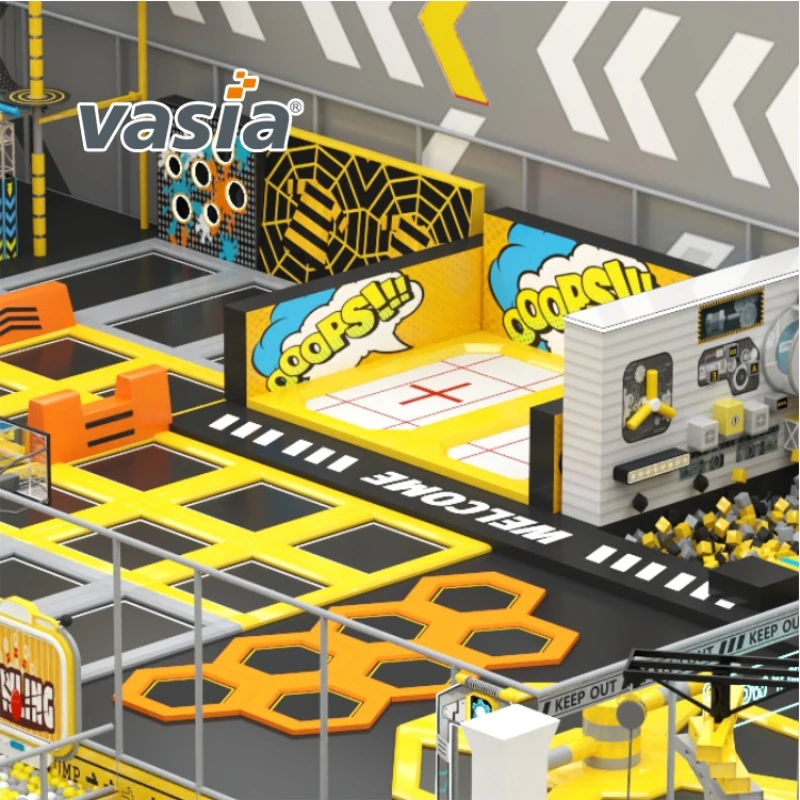
Your service line turns a building into a place families want to visit. Vasia playground supplies the indoor playground equipment that holds your floor plan together: slides, trampolines, rope courses, ninja courses, and soft play areas. You can set these up in zones that fit your audience. A soft play area works well for toddlers, while a ninja course and rope course give older kids a challenge. Slides and trampolines act as the main attraction that pulls families across the room.
Customization gives your venue its own special look. Vasia offers themed designs, such as jungle, space, and modern styles, plus layouts made to fit your space. The company handles design, manufacturing, and installation from start to finish, so you go from idea to opening without dealing with several vendors. This one-vendor approach makes your business model simpler and keeps your timeline on track.
Add-on services bring families back and raise the money each family spends. Think about these options:
- Party bookings and party packages, with room, food, and play time all in one
- Field trips for students and school groups
- Special events tied to holidays and seasons
- Punch passes and daily admission
- Membership discounts that reward visitors who come often
- Sensory-friendly sessions with lower lights and less noise
Birthday parties should get their own line in your plan. They book at high rates and often turn first-time guests into regulars. Pair each party package with admission so families stay longer and spend more.
Safety, Cleanliness, and Accessibility
Safety planning begins with the equipment you buy. Vasia indoor playground products meet ASTM, EN, CSA, AS, and NZS safety standards. That compliance gives lenders and parents a clear sign that you built on a recognized foundation. The equipment uses strong, non-toxic materials, and the design includes padded surfaces and rounded edges.
Cleanliness protects your reputation in the indoor playground industry. Clean the playground every day with kid-safe products, and use machines such as ball washers to reach equipment quickly. Put hand-washing stations or sanitizer near the entrance, and ask visitors to remove shoes to keep out dirt and germs.
Accessibility brings in more customers. Poured-in-place rubber flooring meets ADA rules, and wide doors, ramps, and open pathways support access for everyone. Add multi-sensory elements, quiet rest areas, and play challenges that step up in difficulty. Provide plenty of seating with clear views of the play equipment, plus charging stations and coffee nearby. Train staff for emergencies, and make sure every spot sits close to an exit.
| Standard | Region | What It Covers |
|---|---|---|
| ASTM F1918 | North America | Safety performance for soft contained play equipment |
| EN 1176 | Europe | Design, construction, and installation safety |
| CSA | Canada | Canadian safety compliance |
| AS 3533 | Australia | Amusement and play equipment safety |
| NZS 5828 | New Zealand | Playground safety standard |
Write these standards into your plan as a planning strength. They show you thought about risk before you opened the doors.
Marketing and Sales Strategy
Channels That Reach Local Families
You need a mix of channels to reach parents where they already spend time. Start with paid social media ads on Facebook and Instagram. Target local parents by demographics and by interests like parenting, family activities, and local events. Test photo, video, carousel, and Stories ad formats to learn what earns clicks. Post organic visuals of kids enjoying your attractions every day, and link each post to a landing page.
Build trust beyond the screen. Pursue local media coverage in news, TV, and radio to reach parents who skip social media. Invite local bloggers, parenting influencers, and community leaders to tour your playground and attend your opening. Partner with nearby businesses for joint promotions and discounts. Collect emails through sign-up incentives, then nurture interest with event updates and member perks. A referral program rewards members for bringing friends, which strengthens word-of-mouth reach.
Opening-Week Promotions
Your opening week sets the tone for repeat visits. Offer a first-time visitor discount to drive trial, and launch a loyalty program with stamp cards or points redeemable for food and beverages. Run discount days on slow mornings to fill quiet hours with parents of young children.
Host themed events and bundle meals, cake, and décor into a party package for birthday parties. Pre-sell day camp packages that combine crafts, activities, and childcare. Offer local schools and churches special discounts and fundraising revenue shares. Invite local news to your grand opening, or host a free family party for publicity. Distribute flyers with coupons in high-traffic areas, and list special deals in local directories.
Funding Request Basics
Estimate Startup Costs Realistically
Lenders trust numbers you can back up. Build your start-up cost estimates from written quotes, not guesses. Ask equipment suppliers, contractors, and your landlord for estimates. Then put each figure in a table so the reader sees the whole picture.
The cost to open an indoor playground changes a lot by size and market. Playground equipment alone runs from $20,000 to $500,000 or more. A multi-level commercial structure costs $75,000 to $300,000 or more, while a toddler soft play area runs $8,000 to $25,000. Add a lease deposit of $5,000 to $50,000 or more, renovations of $25,000 to $300,000 or more, and permits and inspections of $1,000 to $20,000 or more. Insurance adds $2,000 to $15,000 or more each year, and early marketing adds $2,000 to $25,000 or more. Keep working capital in the budget too.
Show How Funds Will Be Used
A lender wants to see exactly where each dollar goes. List every setup need, then attach a quote to each line. Your projected start-up costs should cover these categories:
- Furniture, paint, and signs
- Indoor playground equipment and arcade games
- Safe flooring and stock such as toys or prizes
- Staff uniforms and safety compliance costs
- Commercial utilities and security, if your landlord does not cover it
Build one master budget that shows which funding source pays each cost. Keep installation and site prep separate from equipment, because some grants limit construction costs. Plan accessible features and safety surfacing together so compliance work stays in one line. Check match rules and don’t claim the same expense twice. This level of detail shows lenders you take the request seriously.
Financial Projections Made Simple
Forecast Admissions and Party Revenue
Begin your forecast with the revenue streams you already planned. Industry benchmarks show walk-in admissions make up 25–40% of total revenue, and birthday parties make up 15–30%. Food and beverage adds 10–20%, and memberships add 5–15%. A healthy venue draws on four to six sources of revenue, and that mix keeps your monthly cash flow steady.
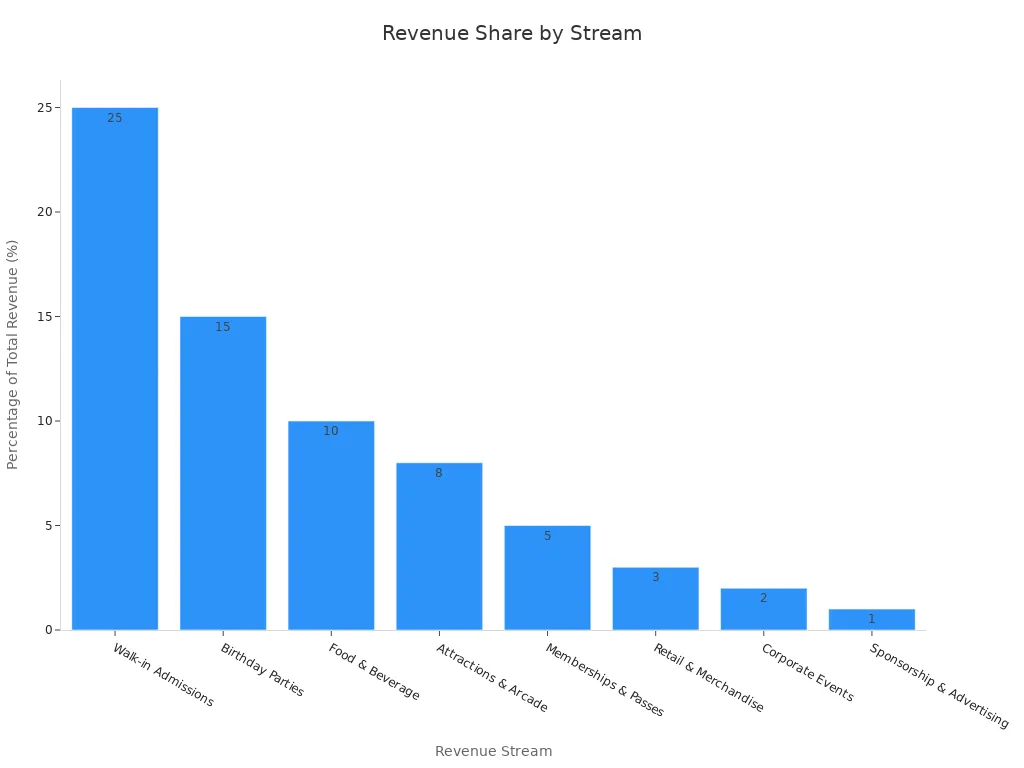
Build a month-by-month cash flow across 36–60 months. Use a careful ramp curve, seasonality, and party booking cadence. Then stress-test with 20% less revenue and 15% higher operating cost. Successful locations often report payback between 2 and 5 years. Results outside that range usually point to problems with pricing, volume, or cost structure. These projections form the backbone of a profitable indoor playground business plan.
Track Break-Even and Cash Flow
Break-even math is simple when you keep it in plain words. Contribution per visit equals average price minus variable cost per visit. Monthly break-even visits equal monthly fixed costs divided by contribution per visit. Party contribution equals package price plus add-ons minus host labor, food, supplies, and payment fees. Cash runway equals opening cash divided by average monthly net cash burn before break-even.
Run each revenue source through this test. Stress lower attendance, higher wages, opening delays, and weaker party demand. Run the test twice: planned demand, then 10% fewer visits or 30 days of delay. Confirm ending cash stays positive under both runs. Track cash-timing checkpoints such as lease deposits, equipment order deposits, and pre-opening payroll.
Appendix and Next Steps for Starting an Indoor Playground
Permits, Licenses, and Insurance
The appendix holds the papers that show your plan is real. Start with business licensing and compliance. Your city or county usually requires a general business license, a zoning or occupancy permit, and a health permit if you sell food. Fire officials may inspect your space and set a limit on how many people can be inside. List each permit, the agency that issues it, and the expected timeline. Attach the actual application forms or screenshots of the online portals.
Insurance deserves its own page. General liability coverage protects you when a child gets hurt on the equipment. Commercial property insurance covers your playground structures and fixtures. Ask your broker about coverage for party bookings and special events. Include a certificate of insurance in the appendix, or a written quote from a licensed carrier. Lenders and landlords both ask for this document when you open an indoor playground, so gather it early.
Resumes, Quotes, and Lease Drafts
Lenders want to know who runs the business. Add one-page resumes for every owner and key manager. Highlight childcare experience, facility management, or retail operations. If you lack direct experience, show relevant training or a hired consultant with a track record.
Attach written quotes for every major cost line. Equipment quotes from Vasia playground, contractor bids for flooring and renovation, and signage estimates all belong here. Include the signed or draft lease with rent terms, escalation clauses, and maintenance duties spelled out. Personal financial statements and tax returns round out the package. These documents let a reviewer check your numbers without calling you. When you start an indoor playground, this evidence separates a serious plan from a wish list. Keep copies organized in one folder, and update the appendix whenever a quote expires. A clean appendix makes starting an indoor playground far less stressful, because every claim in your plan has a paper trail behind it.
How to Start an Indoor Playground Business Plan
Build It One Section at a Time
Think of the plan as a pile of small jobs, not one huge task. Write a rough draft of the executive summary first, then come back to it at the end. Cover the business concept, mission, vision, market opportunity, key services, and financial projections. A sample plan can show revenue growing from $450,000 in Year 1 to $702,000 in Year 3, with net margins of 18%–29%. Next, move to the business description, where you name the legal structure and list your climbing walls, obstacle courses, soft play zones, and toddler area. Then follow with the sales strategy, the management team and its organization chart, the operations plan, and the financial plan. This order covers the basics of starting an indoor playground without feeling overwhelmed.
Set a small daily goal. Draft one section per sitting, and wait for your quotes before you do the numbers in the financial plan. When you learn how to open an indoor playground, you learn that momentum matters more than perfection. Keep moving forward, and fix weak spots on the second pass.
Refine With Templates and Feedback
You do not need to build every page from scratch. A free indoor playground business template from Upmetrics gives you instructions and examples you can customize. An AI plan generator such as Bizplanr can produce a detailed draft in minutes after you answer a few questions. A paid toolkit priced at $27 bundles a 34-page proven business plan template, a 70-minute video walkthrough, and a replay of a 2.5-hour live Q&A workshop. Any solid business plan template saves you hours of formatting.
Then ask someone else to look at it. Ask a lender, a local small business advisor, or an experienced owner to read your draft. They will spot weak assumptions in your revenue forecast and unclear roles in your management section. Revise, resubmit, and repeat. Creating a business plan works best as a loop, not a single event. Owners who master how to start an indoor playground business this way finish faster and borrow with more confidence. The same habit serves you well when starting an indoor playground in a new market later.
A complete indoor playground business plan is just nine straightforward sections. You tackle them one at a time, and the whole document takes shape faster than you expect. Simplicity comes from writing the Executive Summary last. Fill every part with plain facts and realistic numbers, and the plan reads clean from start to finish.
Start today with one section, such as the Company Description. That single page builds momentum for the rest. The indoor playground industry keeps growing at a healthy pace, so your timing is strong. Begin drafting this week, and grab a free template to speed up the work.
FAQ
How long does it take to write an indoor playground business plan?
Most owners finish a good draft in a few weeks. You write one section at a time and wait for supplier quotes before you build the financial numbers. The executive summary comes last, so the final pass goes fast once every other part is done.
Do you need business experience to write this plan?
No. The nine sections follow a standard order, and each one builds on the part before it. Plain facts and realistic numbers matter more to lenders than a long career. A hired consultant or advisor can fill gaps in your management section.
Which section should you write first?
Start with the Company Description. It names your mission, legal structure, and location, and it gives you a base for the market analysis and financials. Draft a rough executive summary early, then rewrite it at the end with your final numbers.
How much detail do lenders expect in the financial section?
Lenders want month-by-month cash flow, a clear repayment schedule, and quotes behind every major cost line. Show your break-even math and stress-test it with lower attendance. Attach equipment, renovation, and insurance quotes in the appendix so a reviewer can check your figures.
Can you use a template instead of starting from scratch?
Yes. A free or paid template gives you the structure and examples, and you customize each section with your own market data and quotes. Ask a lender or local advisor to review your draft before you submit it. Templates save formatting time, not thinking time.