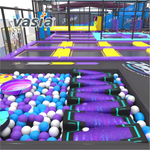
From Concept to Opening: A Playground Procurement Roadmap
Planning a playground is a journey, not a single transaction. Each phase builds on the one before it, and the path runs from first concept to opening day. School administrators, park managers, and recreation planners can follow the same sequence: define scope, select equipment, confirm safety and compliance, build the budget, evaluate suppliers, then manage delivery and installation.
A structured procurement process reduces costly surprises and keeps the project on time and on budget. Clear specifications also make supplier quotes comparable, so a commercial playground equipment manufacturer can price the same brief. Treat the commercial playground project as a series of decisions. Every playground equipment purchase then becomes easier to justify, and most commercial playground projects reach opening day without avoidable delays.
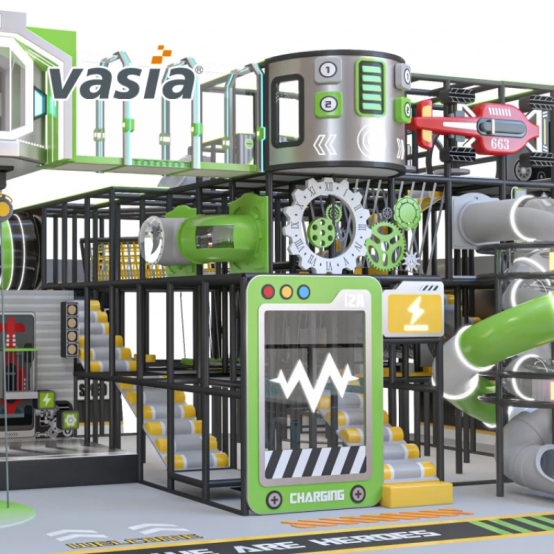
Key Takeaways
- Start by defining your project scope. Check the site and figure out which children will use the playground.
- Pick equipment that fits different ages and skill levels. Compare materials to see which ones last longer and are safer.
- Check safety standards and certifications in writing. Make sure the playground is accessible and inclusive for all children.
- Make a full budget that includes equipment, site work, surfacing, and long-term upkeep. Look into grants and split the project into phases to manage costs.
- Look at suppliers closely. Ask about wait times, warranties, and help with setup. Compare quotes item by item so you don’t miss hidden costs.
Define Project Scope
Scope sets the limits for every choice that comes later. A clear scope tells the design team what the site can hold, who will use it, and what the finished space must achieve. Whether the buyer is planning a school yard, a public park, or an indoor playground project, this phase prevents rework later.
Assess Site and Space
Site conditions shape layout and equipment choices before any product is picked. CRS4Rec notes that slopes, drainage, and soil conditions affect accessible pathways and surfacing choices. Steep grades may limit some play elements or call for terracing, and poor drainage affects how long surfacing lasts and how much upkeep it needs. Creative Systems adds that a slope may work well for a slide but needs extra drainage control.
Sun and shade also shape the design. Long sun exposure calls for built-in shade solutions that keep play comfortable during warmer months. Existing trees give natural shade, but planners must check them for safety and distance from equipment. Underground utilities and pathways limit where play zones can go.
| Site Factor | Effect on Layout and Equipment |
| Topography and drainage | Steep grades may require terracing; poor drainage affects surfacing and maintenance |
| Sun and shade | Shade structures or trees extend comfortable play and reduce UV exposure |
| Existing features | Trees, utilities, and paths limit equipment placement and future expansion |
Identify Users and Goals
User profiling starts with the children who will use the space. Playground Depot advises planners to review reach, grip, balance, mobility, and confidence, and to plan for children needing mobility support from the start. The CPSC Public Playground Safety Handbook groups users as toddlers (6 through 23 months), preschool-age children (2 through 5), and school-age children (5 through 12), with overlapping bands that reflect fluid development. ASTM F1487-21 covers public-use equipment across a 2-to-12 range but leaves out equipment for children 6 to 24 months.
Goals then turn into design intent. An indoor playground business plan might put sensory play and layout flow first, while a park may favor inclusive play and sustainability. Any indoor playground business should also weigh capacity, supervision sightlines, and room to expand. Writing these goals down early keeps the commercial playground project on track, and it gives every commercial playground projects team a shared reference for safety reviews and budget decisions.
Select Commercial Playground Equipment
Equipment selection turns the scope into a real layout. Buyers should match products to the people who will use them. Then they should compare how each option holds up over years of public use.
Match Equipment to Ages and Abilities
Age zoning keeps every user challenged without overwhelming younger children. Playground Expedition divides equipment into three broad categories, and each group has different developmental needs.
| Age Group | Developmental Focus | Suitable Equipment |
| Toddlers and preschoolers (6 months – 5 years) | Early motor skills, curiosity, parallel play | Low slides, swings, sensory panels |
| School-age children (5 – 12 years) | Complex physical and cognitive skills | Climbing structures, monkey bars |
| Teenagers (12 and above) | Advanced physical ability | Challenging, high-skill elements |
Swings and slides build balance, strength, and coordination in toddlers. Climbing walls and monkey bars push older children toward more complex movement. Interactive panels and sensory structures get kids thinking and solving problems, while see-saws and mazes teach cause and effect. Shared play areas encourage turn-taking and cooperation.
Safety standards guide the spacing of these zones. The CPSC recommends swings be spaced at least 24 inches apart. The safety zone around a swing set should extend at least six feet in all directions from the furthest swing. Clear sightlines for supervision matter just as much. Planners comparing indoor options should consult a commercial indoor playground equipment guide before finalizing layouts, because indoor clearances and supervision angles differ from outdoor ones.
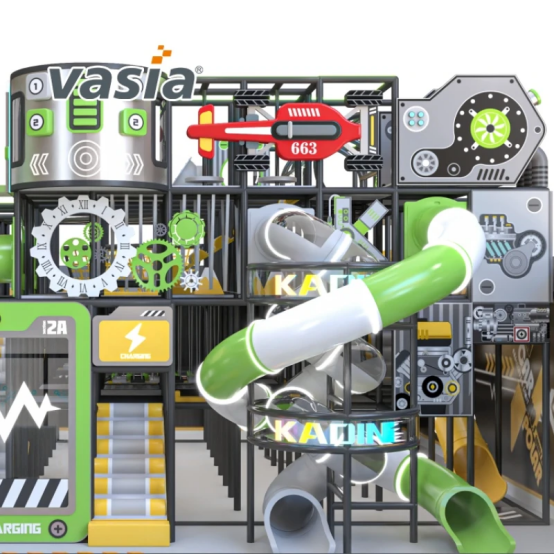
Compare Materials and Designs
Material choice affects durability, safety, and long-term cost. Playground Expedition compares the main options. Wood offers natural aesthetics and tactile warmth, yet it needs regular upkeep against decay and warping. Metal brings strength and vandal resistance, though untreated steel can rust and heat up in direct sun. Rotomolded plastic resists heat and splinters, but its load-bearing capacity is limited.
Durability details deserve close attention during playground design and manufacturing review. Recreation Installations advises heavy-gauge steel components, reinforced joints, UV-stabilized plastics, tamper-resistant hardware, and stainless or coated fasteners. Hardware failure often weakens a structure first. A longer warranty usually signals better construction, though it typically covers manufacturing defects only.
Commercial-grade equipment is built for frequent use, repeated loading, and year-round exposure. Buyers should compare thicknesses, corrosion protection, and testing documentation. For a commercial indoor playground, durability also means resisting constant traffic in a controlled climate. Anyone drafting an indoor playground business plan should weigh sensory play and layout flow alongside material specs. A commercial indoor playground serves different traffic patterns than a park, and equipment configuration must reflect that. Careful equipment configuration planning keeps sightlines open and separates active zones from quiet ones. The same discipline applies to any commercial indoor playground, where equipment configuration shapes both safety and revenue capacity.
Plan a Commercial Indoor Playground Equipment Guide
An indoor build follows different rules than an outdoor one. A commercial indoor playground equipment guide should cover safety surfacing, durability, sensory play, and layout flow. These four criteria decide whether a commercial indoor playground works for play cafes and indoor centers.
Evaluate Commercial Indoor Playground Equipment
Layout flow comes first. Worlds of WOW recommends main walkways 48 inches wide for heavy foot traffic and stroller access. Clear paths should run from the entrance to play zones, party rooms, and restrooms. Bottlenecks often form at slide exits and tunnel transitions, so planners should map crowded spots early. Supervision zones need staff stations with clear sightlines and cameras covering blind spots.
Durability and sensory value come next. Steel frames give elevated structures a strong strength-to-weight ratio. Rotomolded plastic and high-density polyethylene panels resist scratching and fading. Soft play uses high-density foam wrapped in fire-retardant PVC or PU leather, and Happy Zone notes these materials meet EU and US standards. Sensory features add depth to any indoor playground layout:
- Tactile walls with varied textures
- Light and sound panels that respond to input
- STEM activities and cause-and-effect stations
- Graduated challenges that build problem-solving
Choose an Indoor Playground Equipment Manufacturer
Supplier selection deserves the same care. Buyers should check customization, automation, and inspection practices before signing. Playground Expedition advises working with manufacturers to tailor equipment to space needs and play goals. Independent testing and certification documents confirm compliance. Automated systems for booking and ticketing also help operations run smoothly.
| Factor | What to Verify |
| Customization | Tailored designs for space and play goals |
| Automation | Booking, ticketing, and inventory systems |
| Inspection | Certified post-installation safety checks |
Sanhui Machinery shows this model well. The company offers customized solutions, strict product inspection, training, parts, and warranty support. That mix supports manufacturing and quality control through the whole life of an indoor playground project. A strong indoor playground manufacturer partnership helps operators build safe, durable and profitable indoor parks.
Ensure Safety and Compliance
Safety compliance starts with written standards, not just verbal promises. Buyers should confirm each certification in writing before they sign a purchase order.
Verify Standards and Certifications
A trustworthy supplier names specific standards by number. AAA State of Play lists the main references buyers should check. ASTM F1487 covers public equipment for children ages 2 through 12. It sets limits on fall heights, protrusions, and openings, which must measure under 3.5 inches or over 9 inches. ASTM F2373 covers equipment for children 6 months through 23 months. ASTM F1292 tests how well surfacing absorbs impact, and ASTM F1951 tests surfacing accessibility.
| Standard / Certification | What It Covers |
| ASTM F1487 | Core equipment standard for ages 2–12 |
| ASTM F2373 | Equipment for children 6–23 months |
| ASTM F1292 / F1951 | Surfacing impact and accessibility testing |
| CPSC Handbook | Industry baseline for use zones and maintenance |
| IPEMA | Third-party validation of ASTM compliance |
| ADA | Legal accessibility requirement |
The CPSC Public Playground Safety Handbook sets minimums of 12 inches of loose-fill surfacing and a 6-foot use zone around most equipment. IPEMA certification gives independent lab validation, and buyers can search the public database by manufacturer and product. ADA compliance is a legal requirement, not a choice. A Certified Playground Safety Inspector should review the installed site against these criteria.
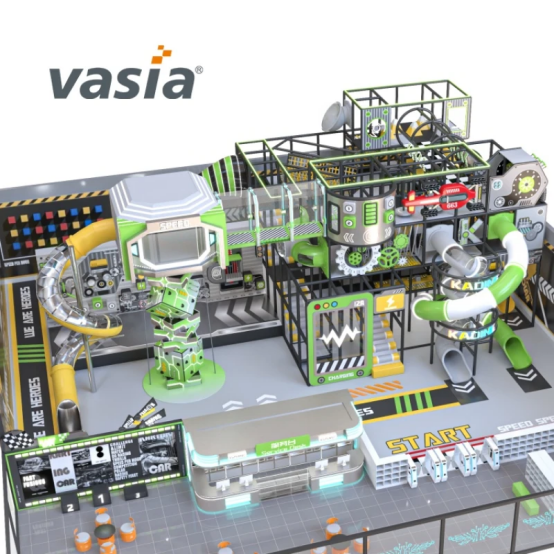
Design for Accessibility and Inclusion
Accessibility is the floor, and inclusion is the goal. The ADA requires accessible routes, varied ground-level components, and ramps that connect at least 25% of elevated components on structures with 20 or more. Inclusive design goes further. The IFLA World advice covers site access, multiple ways to engage, visual connections between levels, extra handholds, sensory elements, and quiet retreat zones.
The Landscape Structures design guide frames seven principles, including equitable use, flexibility, and tolerance for error. Pathways should be short and direct, with 60 inches encouraged so a wheelchair and a companion fit side by side. Unitary surfacing such as poured-in-place rubber supports wheelchair travel. Shade, backed benches, and symbol signage round out a space that welcomes every child.
Build Budget and Funding Plan
Cover All Cost Categories
Equipment is often not the biggest part of the final bill. Playground Depot suggests planners list site work and product costs separately. Demolition, grading, drainage, foundations, and delivery access can really change the total. Kraftsman Play adds concrete footings, accessible paths, shade structures, borders, ramps, seating, permit fees, freight, and insurance to that list. Surfacing often takes a large share of the budget, whether the team picks engineered wood fiber, bonded shredded rubber, synthetic turf, or poured-in-place rubber.
A full budget also pays for inspection and long-term care. Kraftsman Play recommends a Certified Playground Safety Inspector audit before opening. After that, do weekly high-frequency checks and quarterly or semi-annual low-frequency checks. Yearly funds should cover new surfacing, hardware replacement, and refinishing. For an indoor playground project, the indoor playground startup cost works the same way. Design, equipment, freight, installation, surfacing, inspections, taxes, and contingency all belong in the indoor playground investment plan. A realistic indoor playground startup cost keeps the indoor playground business plan credible with lenders and partners.
- Design and engineering fees
- Equipment, freight, and taxes
- Demolition, grading, drainage, and foundations
- Surfacing, borders, and accessible routes
- Installation, permits, and CPSI inspection
- Contingency and annual maintenance
Explore Funding and Phasing
Few organizations pay for a playground from one source. GameTime describes a funding stack of district capital dollars, grants, PTO support, donations, sponsorships, and financing spread across budget years. Playworld notes that most grants need no repayment, and its grant guide tracks more than 30 national funding sources. Cooperative purchasing contracts, equipment leasing, and fundraising campaigns round out the options.
Phasing stretches every dollar. GameTime suggests funding site work first, then the main play system, then shade or amenities. Each phase must still create a space that works and meets the rules. Reimbursement-style grants still require cash reserves or bridge financing. Every indoor playground business should build these realities into its indoor playground business plan. An indoor playground business plan that phases construction lowers risk, and a phased indoor playground investment plan protects cash flow. The indoor playground business gains flexibility, the indoor playground project stays on schedule, and the indoor playground business plan remains the single reference for spending decisions. Careful planning also supports safety at every stage.
Evaluate a Commercial Playground Equipment Manufacturer
Supplier evaluation decides whether the project runs smoothly after the contract is signed. A capable commercial playground equipment manufacturer answers hard questions in writing. The same discipline applies to an indoor playground equipment supplier, where customization and service matter just as much as price.
Ask the Right Supplier Questions
Lead time questions come first. MVP Playgrounds advises buyers to ask when equipment will ship and what could affect the timeline. Buyers should also ask how delivery will be coordinated and when installation can realistically occur. Lead times vary by product line, customization, manufacturing schedule, seasonality, freight, and installation availability. Playground Depot reports that most made-to-order playgrounds ship in roughly 11–14 weeks, while in-stock options move faster.
Warranty questions deserve equal weight. MVP Playgrounds suggests asking which components are covered and how long each coverage lasts. Buyers should also ask what is excluded, whether labor is included, and who handles claims. They should also ask which maintenance records to keep. Installation support also belongs on the list. Playground Depot confirms turn-key installation nationwide, and community-build options can cut installation costs by 30–40%. Every indoor playground manufacturer should answer these same questions before an indoor playground business commits.
Read Quotes and Warranties
Quotes rarely arrive in comparable form. Creative Systems recommends normalizing each offer into the same categories and listing exclusions, allowances, and alternates. Compare product scope, documents, shipping, site work, installation, surfacing, warranty, closeout, and schedule. Resolve every gap in writing before award.
A line-by-line table exposes hidden differences. Zzrsplay publishes a comparison framework that records equipment configuration, material specification, foundations, surfacing, delivery, assembly support, after-sales terms, and commercial conditions for each bidder. A blank cell is an unanswered question, not a zero-cost item. Zzrsplay also illustrates the trap: one quote shows equipment at USD 20,000 against USD 24,000, yet the subtotal gap shrinks to USD 1,000 once freight, installation, and surfacing align. The chart below, from Zzrsplay, compares the two quotes across those line items.
Warranty language needs the same scrutiny. Creative Systems warns that headline terms can conceal component limits and owner costs. Buyers should separate structural coverage from finishes, plastics, ropes, moving parts, hardware, and surfacing. They should confirm who pays diagnosis, removal, labor, freight, and reinstallation, and how discontinued parts are handled. Playground Depot notes that coverage commonly includes lifetime warranties on steel posts and stainless hardware, with up to 15-year terms on plastics, decks, rails, and structural components. AAA State of Play backs structural components with a 100-year warranty to the original owner.
Sanhui Machinery shows what a customer-centric partnership looks like. The company provides customized solutions, training, parts support, and warranty services. That model extends past the sale and supports safety across commercial playground projects. Any indoor playground equipment supplier should offer comparable depth, and every indoor playground manufacturer should document it. An indoor playground business gains confidence when its indoor playground manufacturer stands behind the build. A reliable indoor playground equipment supplier protects the playground investment for years.
Plan Delivery and Installation
Coordinate Site Prep and Assembly
Installation follows a four-stage sequence, and each stage must be finished before the next one starts. Zoom Recreation outlines the process clearly.
- Site preparation: the team clears debris, levels the ground, grades to plan, and marks where each structure will go. Play areas must sit within a 2% slope. Crews must also mark underground utilities through DigAlert before any digging.
- Equipment reception and storage: receiving staff count every part and manual, report damage to the manufacturer, and store components away from bad weather.
- Installation: certified installers put the structure together, post warning labels around hazardous zones, and keep records of the site throughout.
- Operation and maintenance: monitoring and upkeep begin on opening day.
A trained crew certified on that specific brand of equipment is a must. Storage containers, temporary fencing, and heavy machinery should be on site before work starts.
Schedule Around Inspections
A timeline built only on manufacturing lead time will slip. Noah’s Play warns that city approvals sometimes demand extra paperwork or revisions before construction begins. AAA State of Play treats approval gates as schedule-critical, because they are the points where the city becomes accountable in writing. Submittals that fail to define age range, use-zone intent, surfacing, and accessibility routing trigger repeated review cycles.
Closeout verification is a real timeline event, not just a formality. ASTM F1487-25, Sections 11.2.2 and 11.3.1, requires installers to install per instructions and get written verification from a qualified person before first use. Build that milestone into the plan while the installer can still fix problems. Start planning months ahead, lock colors and layouts before production, and hire professionals who understand permitting and equipment installation sequencing. These habits keep commercial playground projects reviewable and protect safety at every gate.
Maintain for the Long Term
Opening day is the start of the equipment’s service life, not the end of the project. A written maintenance plan protects the investment and keeps every structure safe.
Set a Maintenance Schedule
Routine care starts small. Staff remove litter, check the surface for hazards, and make sure access is clear every day. Weekly checks on the playground cover bolt tightness, cracked plastic, frayed ropes, and worn connectors. Playground Expedition publishes a frequency table that planners can adapt to local use.
| Frequency | Core Tasks |
| Daily | Litter removal, visual inspection, surface hazard check |
| Weekly | Structure stability, surfacing resilience, moving parts, bolts, ropes |
| Monthly | Full apparatus review, anomaly log, manufacturer guideline check |
| Annual | Certified inspector audit of structure and compliance |
The annual audit should be done by a qualified professional. Playground Depot recommends a detailed structural inspection each year, plus staff training on spotting faults and taking corrective action. A written log of every inspection and repair helps with warranty claims later. Crews should also lubricate moving parts and refinish faded coatings, since Playground Expedition notes that chipped paint exposes materials to UV light and moisture. Seasonal work matters too. Playground Expedition advises freeze-thaw checks in winter, surface replenishment in spring, heat and shade review in summer, and leaf removal in autumn. Playground Guardian suggests reviewing the schedule regularly and adjusting it as equipment ages.
Plan for Parts and Support
Spare parts decide how fast a repair happens. Zzrsplay advises buyers to keep critical spares on hand and to define freight, response time, and responsibility in the contract. A stock of swing seats, chains, and hardware shortens downtime considerably.
Manufacturer support extends the equipment’s life. CCE Magazine notes that replacement parts are easy to get through local consultants, and detailed maintenance procedures ship with the equipment. Bliss Products handles design, inspections, installation, and ongoing support as one package. Sanhui Machinery follows a similar customer-focused model, with customized solutions, training, parts support, and warranty services. That partnership keeps the playground in service for years.
Procurement follows a repeatable sequence: scope, equipment, compliance, budget, supplier selection, and installation. Each phase feeds the next, and skipping one invites rework later. Early planning and careful supplier evaluation remain the biggest levers for a smooth opening. Teams that lock scope and vet manufacturers before signing avoid the delays that derail tight schedules.
Readers should start with the first phase and work through each step methodically. A reputable manufacturer supports every stage, from layout advice to parts and warranty service. That partnership protects both the budget and long-term safety. A well-run playground project rewards patience, and the finished playground serves the community for years.
FAQ
How long does a typical playground project take from order to opening?
Playground Depot says most made-to-order playgrounds ship in about 11–14 weeks. Planners should add site preparation, installation, and inspection steps on top of that window. City review schedules often make the timeline longer than the manufacturing lead time.
How much of the budget should go to equipment?
Equipment is rarely the biggest part of the final bill. Site work, surfacing, installation, permits, and inspection take a large share. Playground Depot advises listing site work and product costs separately. A contingency line protects the project when surfacing or drainage costs go up.
What differs between an indoor and outdoor playground purchase?
Indoor builds focus on layout flow, soft surfacing, and clear supervision sightlines. Worlds of WOW recommends main walkways 48 inches wide so strollers can pass. Outdoor projects add drainage, shade, and use zones of at least six feet around most equipment. Both paths need a certified inspection before opening.
Which warranty terms deserve the closest review?
Buyers should separate structural coverage from finishes, plastics, ropes, and hardware. They should confirm who pays for labor, freight, and reinstallation. Playground Depot notes common coverage includes lifetime terms on steel posts and up to 15 years on plastics and decks. Written maintenance logs help with future claims.
What is the first step for a new playground project?
Scope comes first. Planners should assess the site, profile the intended users, and write down project goals. Every later decision—equipment, budget, and supplier questions—rests on that foundation. A reputable manufacturer can advise at this stage before any purchase commitment.