Outdoor Playground Equipment Procurement for Multi-Site Operators
Buying outdoor playground equipment for several locations requires a shared specification and a separate plan for each site. A public park, a school, and a residential community may use similar equipment, but their users, ground conditions, access routes, and opening dates can differ. One delayed foundation or missing approval can affect several deliveries if the rollout has no clear checkpoints.
This guide focuses on public-use outdoor playgrounds for parks departments, school groups, residential developers, and community associations. It explains how to work with a commercial playground equipment manufacturer, compare complete project costs, and manage delivery, installation, and maintenance across a portfolio.
Start with a site list, an opening target for each location, and a budget that separates equipment from local construction. These three records form the basis of a useful procurement brief for Vasia.
Key Takeaways
- Use one procurement framework, with a separate site schedule for dimensions, users, climate, and access.
- Select outdoor equipment by age group, play goals, expected use, and exposure to weather.
- Match safety documents to the destination market, quoted models, surfacing, and approved layout.
- Compare itemized installed project costs using the same scope, currency, and pricing basis.
- Release each delivery against site readiness and maintain clear records after handover.
Define Scope for Multi-Site Procurement
Create a master brief before requesting designs. It should list the number of sites, decision makers, approval process, target dates, and purchasing rules. Attach a site sheet for each location. This lets the supplier identify components that can be shared without assuming every playground needs the same layout.
Assess Each Site and Its Users
Survey the usable area, slopes, drainage, utilities, nearby roads, existing structures, and entrances. Record truck access, unloading space, storage options, and any limits on working hours. Confirm the boundaries of the work: replacing equipment on an existing surface is different from developing a new site.
Record age groups, expected peak use, supervision arrangements, and accessibility needs. At a school, check whether several classes use the space together. In a public park, allow for mixed-age family visits. Ask the designer to explain how the proposed activities and circulation respond to these conditions rather than relying on an unsupported capacity claim.
| Site Type | Main Need | Equipment Direction |
| Kindergarten | Age-appropriate play and clear supervision | Low platforms, suitable slides, sensory panels, imaginative play |
| Public park | Frequent use and a broad activity mix | Commercial play structures, climbers, swings, accessible play options |
| Residential community | Everyday family use in a shared outdoor space | Slides, balance features, swings, ground-level activities |
| School playground | Active play and manageable group use | Climbing, balancing, social play, separate activity zones |
Set Play Goals and Site Priorities
Choose a small set of goals for each site, such as balance, climbing, social interaction, sensory exploration, or imaginative play. Include quieter activities and places for caregivers to observe. A consistent visual theme can connect the portfolio while each site offers a different mix of play.
Rank sites by need, funding, approvals, and construction readiness. Name the person who approves each layout and the person who confirms the site is ready for installation. Resolve these responsibilities before production begins so a late local change does not automatically delay every location.
Select Commercial Playground Equipment by Age and Climate
Select equipment for the intended users before choosing its appearance. The CPSC Public Playground Safety Handbook identifies age groups of 6–23 months, 2–5 years, and 5–12 years. Check the manufacturer’s age designation for every quoted model and plan the layout around the relevant requirements.
Match Equipment to Age and Usage
Use the following table as a planning guide, not as approval for an individual product. Activities must be specifically designed and assessed for the stated users.
| Age Group | Equipment Direction | Typical Setting |
| Toddlers (6–23 months) | Purpose-designed low-level play, crawl features, sensory activities | Childcare and designated toddler areas |
| Preschool (2–5 years) | Age-rated slides, low climbers, imaginative and interactive play | Kindergartens, parks, residential communities |
| School age (5–12 years) | Age-rated climbing, balancing, overhead and group activities | Schools and public parks |
Separate busy movement areas from quieter play and keep supervision sightlines clear. Plan accessible routes and meaningful play choices from the start. A ramp or an adaptive swing alone does not establish accessibility for the whole playground; review the route, surfacing, approach space, and access to activities together.
Choose Materials for Durability
Ask for the actual materials and finishes of each model. A specification should identify structural sections, corrosion protection, plastic types, fasteners, ropes, and replaceable wear parts. Avoid general claims that all metal is rustproof or that all plastic has the same outdoor performance.
For coastal sites, request details of the corrosion protection system and maintenance requirements. For hot sites, assess shade and the temperature of exposed contact surfaces. For wet or freezing conditions, review drainage and request evidence relevant to the expected exposure. Compare the offered material specification with its test evidence and warranty conditions.
Vasia playground lists outdoor playground equipment within its product range. When reviewing a Vasia proposal, confirm the exact materials, available finishes, outdoor suitability, and spare-part options for the selected models. Do not apply specifications from one product to the entire range.
Build Safety and Compliance into Procurement
Apply Recognized Safety Standards
State the destination market and applicable requirements in the bid brief. For U.S. public-use outdoor playgrounds, ASTM F1487 addresses equipment within its scope, generally for children aged 2–12. The CPSC handbook provides safety guidance; it is not a product certificate. Local authorities, contracts, or insurers may require particular standards or editions, so confirm those requirements before design approval.
Use the following references where they apply:
- ASTM F1487 for public-use playground equipment within its stated scope.
- ASTM F2373 for public-use play equipment for children aged 6–23 months.
- ASTM F1292 for playground surfacing impact attenuation; the 2026 edition addresses laboratory testing.
- ASTM F3313 for field impact testing of installed surfacing when specified for the project.
- ASTM F1951 for the accessibility performance of playground surface systems.
- ASTM F2075 when engineered wood fiber is selected as the safety surfacing material.
Record the required edition and assessment scope in the contract. For sites outside the United States, have the project team identify the destination’s applicable equipment, surfacing, accessibility, and construction requirements. A U.S. test report does not automatically establish acceptance in another market.
Keep equipment requirements separate from clothing guidance. ASTM F1816 concerns drawstrings on children’s upper outerwear and does not belong in the core equipment procurement checklist. Equipment entanglement hazards must still be assessed under the relevant playground requirements.
Collect Compliance Documentation
Request a project safety file with model references, relevant test reports, material specifications, scaled layouts, foundation details, installation instructions, and surfacing information. Layouts should identify equipment use zones, fall heights, circulation, and accessible routes. Surfacing evidence must correspond to the proposed system and its installation conditions.
Verify report numbers with the issuing laboratory using independently checked contact details. Compare the tested product and materials with the quoted configuration. Check whether the evidence covers custom changes and the contract’s required edition; a report for a standard model may not cover a modified structure.
Distinguish laboratory surfacing results from installed-site acceptance. Agree on any field testing, inspection scope, and responsible parties before ordering. Set document review milestones before production, shipment, and opening, and resolve material gaps before releasing the relevant stage.
Plan Customization and Multi-Site Logistics
Coordinate Custom Designs Across Sites
Use a shared color palette, signage approach, and approved component family where practical. Adapt equipment placement to each site’s dimensions, ages, drainage, and access. Decide how much customization is needed before requesting detailed engineering.
| Decision factor | Standard model | Configured components | Custom design |
| Site flexibility | Fits sites that match existing models | Adjusts an approved component arrangement | Responds to specific site and design needs |
| Visual identity | Available colors and themes | Selected panels, colors, and activity combinations | Project-specific appearance and development |
| Price drivers | Model, quantity, materials | Configuration and interface changes | Design work, unique parts, assessment, tooling where needed |
Ask for a standard option and a tailored option against the same brief. Compare usable activities, maintenance access, documentation needs, and total project cost. Use one approved revision for production, and record any later change with its cost and schedule effect.
Schedule Phased Delivery and Installation
Work backward from each opening date. Include design approval, engineering review, production, inspection, transport, customs where relevant, local delivery, installation, surfacing work, and final acceptance. Identify which dates are firm commitments and which are estimates.
Release deliveries only when access, foundations, storage, and the installation crew are ready. Label crates and packing lists by site and installation sequence. Agree on the process for reporting transit damage, shortages, or mixed deliveries before unloading starts.
Discuss phased packages with Vasia during quotation. Confirm whether production can be released by site and how split shipments affect packing, freight, storage, and payment. Reserve future expansion areas on the plan, but obtain written confirmation of component compatibility before assuming later additions will connect to the original equipment.
Budget for Commercial Playground Equipment Life-Cycle Costs
Capture Upfront and Installation Costs
Build the budget from current, project-specific quotations. Broad published ranges can combine different countries, equipment packages, labor rates, and construction scopes. They are not a reliable substitute for the cost of your approved site plan.
Keep every percentage tied to a named base. An installation allowance calculated as a percentage of equipment price is not the same as a percentage of the completed project cost. Ask contractors to state whether foundations, machinery, travel, and surfacing are included. Replace early allowances with priced scopes before purchase approval.
| Cost Factor | Pricing Basis |
| Equipment | Approved models, quantities, options, and spare parts by site |
| Equipment installation | Separate labor and machinery quote with clear inclusions and exclusions |
| Safety surfacing and installation | Measured area × quoted rate for the specified system, thickness, base, and drainage scope |
| Site preparation | Survey-based quantities for demolition, earthworks, drainage, foundations, and reinstatement |
| Freight and shipping | Packing, shipment plan, destination, delivery terms, unloading, and any storage |
| Design, permits, and inspections | Named services, required reviews, and acceptance scope |
| Duties and taxes | Applicable destination charges and responsibility for payment |
| Contingency | Explicit allowance linked to identified unresolved risks |
For each site, add the non-overlapping line items to calculate the installed project budget. Add shared portfolio costs once, or allocate them consistently across sites. Do not count foundations in both site preparation and installation, or count surfacing labor again if it is included in the area rate.
Use one currency, a stated exchange-rate date where needed, and a clear tax basis. Record quote validity and the delivery term with its named place. Separate committed costs, provisional allowances, and optional upgrades so buyers can see what the approved amount actually covers.
Reserve Funds for Maintenance
Prepare a maintenance budget from the selected equipment and surfacing schedule. Include inspections, cleaning, moving-part replacement, corrosion repairs where needed, surfacing upkeep, and replacement freight. Set the reserve using asset condition, supplier instructions, local service prices, and repair history rather than an unsupported universal percentage.
Compare alternatives over the same planning period. Include the installed cost, expected maintenance and replacement costs, and removal costs where relevant. State the assumptions and test how the result changes if part prices or service frequency rise. Lower purchase prices do not always produce lower operating costs.
Evaluate a Commercial Playground Equipment Manufacturer
Use this stage to assess whether the supplier can deliver the agreed scope. Keep the technical document review in the safety section and the price analysis in the quote comparison, so the same checks are not repeated throughout the process.
Compare Design Support and Project Management
Ask what the supplier prepares and what requires a local designer, engineer, or contractor. A rendering can explain appearance, but it does not replace approved construction information. Confirm who checks the site survey and who resolves interfaces between equipment, foundations, drainage, and surfacing.
| Criteria Area | What to Confirm |
| Design and customization | Layout responsibilities, revision process, and deliverables for approval |
| Custom design process | Permitted changes, technical review, and effects on price and timing |
| Installation and site services | Responsibility for permits, civil works, assembly, surfacing, and handover |
| Lead time | Separate milestones for approval, production, shipment, delivery, and installation |
| Long-term support | Service contacts, replacement-part identification, availability, and response process |
Review completed projects that match your outdoor setting, climate, and delivery scope. For a Vasia reference, request the project location, completion date, supplied equipment, installation photos, and an explanation of which work Vasia performed. Where permission allows, ask for a client reference and supporting handover records.
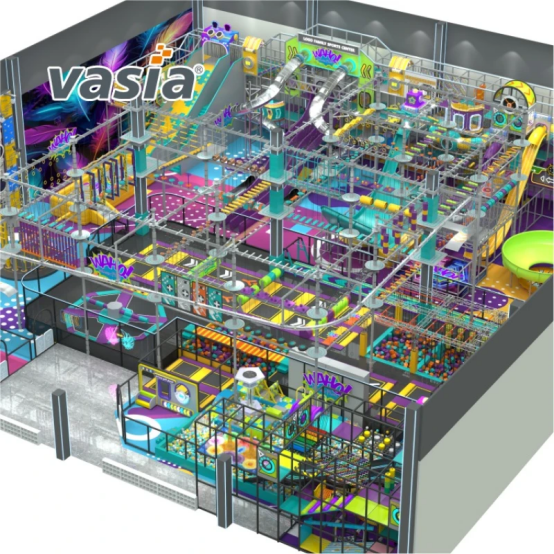
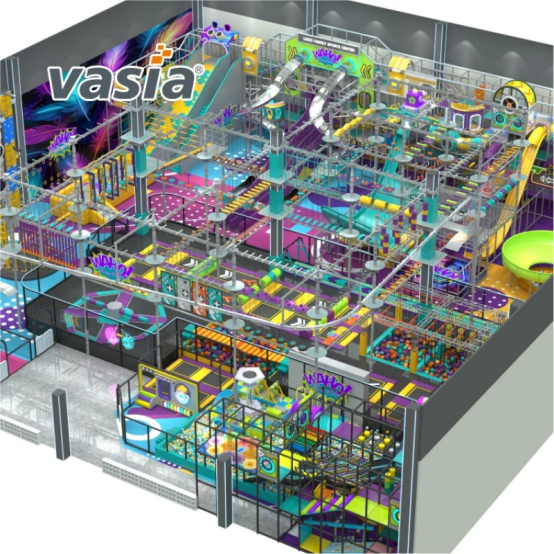
Vasia’s public project pages can introduce its portfolio, but indoor installations do not establish outdoor installation performance or local construction costs. Request a relevant outdoor reference package before relying on a case as procurement evidence. Only use published cost or schedule results when the underlying scope and records can be checked.
Review Warranties and Service Terms
Compare coverage by component rather than accepting a single headline warranty. Structural frames, coatings, plastics, ropes, bearings, and surfacing may have different terms. Check the start date, exclusions, required maintenance, and process for submitting a claim.
- What coverage applies to each quoted component and the project location?
- Who pays for labor, freight, access equipment, removal, and reinstallation?
- What evidence is needed to report a defect and approve a replacement?
- Which spare parts are stocked, and how are discontinued parts handled?
- What installation and maintenance support is included in the contract?
Keep written responses with the purchase agreement. For several sites, agree on a central service contact and a shared parts list, while preserving the warranty and maintenance records for each location.
Manage Purchasing Playground Equipment and Playground Quotes
Run a Fair Quote Comparison
Send the same approved brief to each shortlisted supplier. Require separate equipment, construction, surfacing, logistics, and service prices. List exclusions and alternatives explicitly. A blank cost line should trigger a question, not be treated as a free item.
Set evaluation criteria before bids arrive. Review mandatory technical and delivery requirements first, then score acceptable offers on total cost, design suitability, project support, references, warranty, and schedule. Keep the assumptions behind each adjustment to the quoted price.
For a Vasia proposal, build the comparison from its actual quotation and current local contractor prices. Use the following schedule in place of an unverified supplier-price chart. It is a review template, not a Vasia project case or a claim of savings.
| Comparison Item | Evidence to Request | How to Compare |
| Equipment package | Model list, quantities, materials, drawing revision | Match the same approved play functions and scope |
| Civil works and assembly | Local contractor scope and supplier installation scope | Identify gaps, overlaps, machinery, and foundation costs |
| Surfacing | Measured coverage, system specification, preparation and installation scope | Compare equivalent performance and complete installed cost |
| Logistics | Packing list, delivery term, destination charges, unloading scope | Compare cost to the same delivery point |
| Acceptance and support | Inspection scope, documents, spare parts, warranty costs | Include required services and unresolved allowances |
If a case study is supplied, check its purchase date, currency, site area, equipment list, delivery terms, and included services before using it as a benchmark. An equipment-only export price cannot be compared directly with a locally installed project total. Do not publish a Vasia project budget or saving without supporting records and permission where required.
Standardize the Purchase Across Sites
Maintain an approved equipment list with item IDs and drawing revisions. Attach site-specific schedules covering quantities, layout, foundations, surfacing, delivery address, and acceptance responsibilities. This creates one purchasing system without forcing identical playgrounds onto different spaces.
Standardize compatible replacement parts, finishes, signage, and inspection records where the manufacturer supports it. Require written approval for substitutions and confirm the effect on safety evidence, interfaces, and parts availability. A visually similar component is not automatically interchangeable.
Use a master agreement for shared commercial terms and separate site releases for production and delivery. Record how changes, delays, claims, and partial acceptance affect each release. This helps prevent an unresolved issue at one site from obscuring progress at the others.
Handle Installation and Long-Term Maintenance
Confirm site readiness before dispatch and check deliveries against the packing list on arrival. Install to the approved drawings and manufacturer instructions, with required local engineering and construction checks. Record concealed work, foundation details, and changes before surfacing covers them.
Before opening, complete the agreed inspection and any specified surfacing field tests. Resolve defects, obtain required approvals, and collect the as-built plans, operating instructions, warranties, and inspection records. Keep unfinished areas inaccessible until they are accepted. Installation duration should come from the actual scope and site conditions, not a generic promise.
Standardize Inspection Schedules
Use one inspection record format across the portfolio, but set inspection frequency for each site according to manufacturer instructions, local requirements, use levels, climate, and condition. Include routine visual checks, more detailed operational checks, and periodic assessments by a competent person. Increase checks after storms, vandalism, reported damage, or other events that may affect safety.
Record loose or damaged parts, wear, corrosion, drainage problems, displaced surfacing, and access obstructions. Maintain loose-fill depth and distribution as specified; do not rely on a fixed replacement interval. Assign a responsible person and completion date to each repair, and restrict use where a hazard requires it.
Track Equipment Across the Portfolio
Give each structure and site a unique ID linked to its drawings, model numbers, installation date, supplier, warranty, and service history. Keep replacement-part references and photos available to the maintenance team. Use the same record structure so recurring problems can be compared across locations.
Plan replacement from condition assessments and support availability. Track whether failures are linked to drainage, exposure, use, installation, or component wear. Share these findings with the manufacturer before the next purchase so specifications can improve with each rollout.
For a Vasia multi-site proposal, send the site count, destination, measured plans, age groups, photos, target opening dates, and budget scope. Ask for an outdoor equipment schedule by site, itemized pricing, a compliance document list, relevant completed outdoor references, and a phased delivery plan. Confirm which design, installation, and after-sales services are included before placing the order.
Contact Vasia: https://www.vasiaplay.com/
FAQ
How many sites should you phase at once?
Base each phase on approvals, storage, crew capacity, and construction readiness. A pilot site can help check delivery, assembly, and handover procedures before the remaining releases, but there is no fixed site count suitable for every project.
Which standards should every supplier document?
Specify requirements by destination, age group, equipment type, and surfacing. Use the applicable references listed in the safety section and confirm their editions before contracting. The evidence must match the supplied configuration and agreed project scope.
How do you compare quotes fairly?
Bring every offer to the same installed scope and delivery point. Resolve exclusions, identify provisional amounts, and compare equivalent equipment functions and services. Keep optional additions separate from the required project total.
What belongs in a maintenance reserve?
Include planned inspection and service work, likely wear parts, surfacing upkeep, and repair logistics. Use site conditions and actual service history to update the amount each year.
When should you involve the manufacturer?
Involve Vasia while preparing the site brief, before layouts and budgets are fixed. Supply measured plans and local constraints, then request a scope review and site-by-site quotation. Early involvement also gives time to obtain relevant outdoor references and confirm document requirements.